
The front office department is one of the most important parts of any hotel. It is often called the “face of the hotel” because it is the first and last point of contact for guests. When a guest enters a hotel, the front office staff are the first people they meet. Similarly, when the guest leaves, the final interaction also happens at the front desk. This makes the front office department extremely important in shaping the guest’s overall experience.
In today’s hospitality industry, guest experience plays a major role in business success. According to industry studies, more than 80% of hotel guests say that their first impression at the front desk influences their overall satisfaction. This shows how critical it is to have a well-organized and professional front office team.
The organizational structure of the front office department helps in managing different roles, responsibilities, and workflows efficiently. Without a proper structure, confusion, delays, and poor service can occur. A well-planned structure ensures smooth operations, better communication, and high-quality guest service.
In this article, you will learn everything about the front office department organizational structure, including its meaning, hierarchy, roles, importance, and modern trends.
What is the Front Office Department?
The front office department is the area of the hotel that directly interacts with guests. It handles all guest-related services from the time of booking until the guest checks out. It acts as a communication center between guests and other departments such as housekeeping, food and beverage, and maintenance.
The origin of the front office concept comes from traditional inns and lodges, where a host or innkeeper would welcome travelers, assign rooms, and provide services. Over time, this evolved into a structured department in modern hotels.
The front office performs several important functions. These include reservation management, guest check-in and check-out, handling complaints, providing information, and ensuring guest satisfaction. It also plays a major role in revenue generation because it manages room sales and occupancy.
In simple words, the front office department is responsible for creating a positive first impression and ensuring that guests have a comfortable and pleasant stay. Without an efficient front office, even the best hotel infrastructure cannot deliver a good experience.
What is Organizational Structure in the Front Office?
Organizational structure refers to how different roles and responsibilities are arranged within a department. It defines who reports to whom, what each person is responsible for, and how tasks are managed.
In the front office department, the organizational structure ensures that all operations run smoothly. It helps avoid confusion and improves coordination between staff members. For example, when a guest has a complaint, the structure clearly shows whether the issue should be handled by a receptionist, supervisor, or manager.
The concept of organizational structure originated from management theories developed during the industrial revolution. Today, it is widely used in all industries, including hospitality.
In hotels, the front office structure may vary depending on the size and type of hotel. A small hotel may have only a few staff members handling multiple roles, while a large luxury hotel may have a detailed hierarchy with specialized roles.
A well-defined structure improves efficiency, reduces errors, and ensures better guest service. It also helps in training employees and maintaining discipline within the department.
Hierarchical Structure of the Front Office Department
The front office department follows a hierarchical structure, which means there is a clear chain of command from top-level management to entry-level staff. This structure ensures smooth communication and proper control over operations.
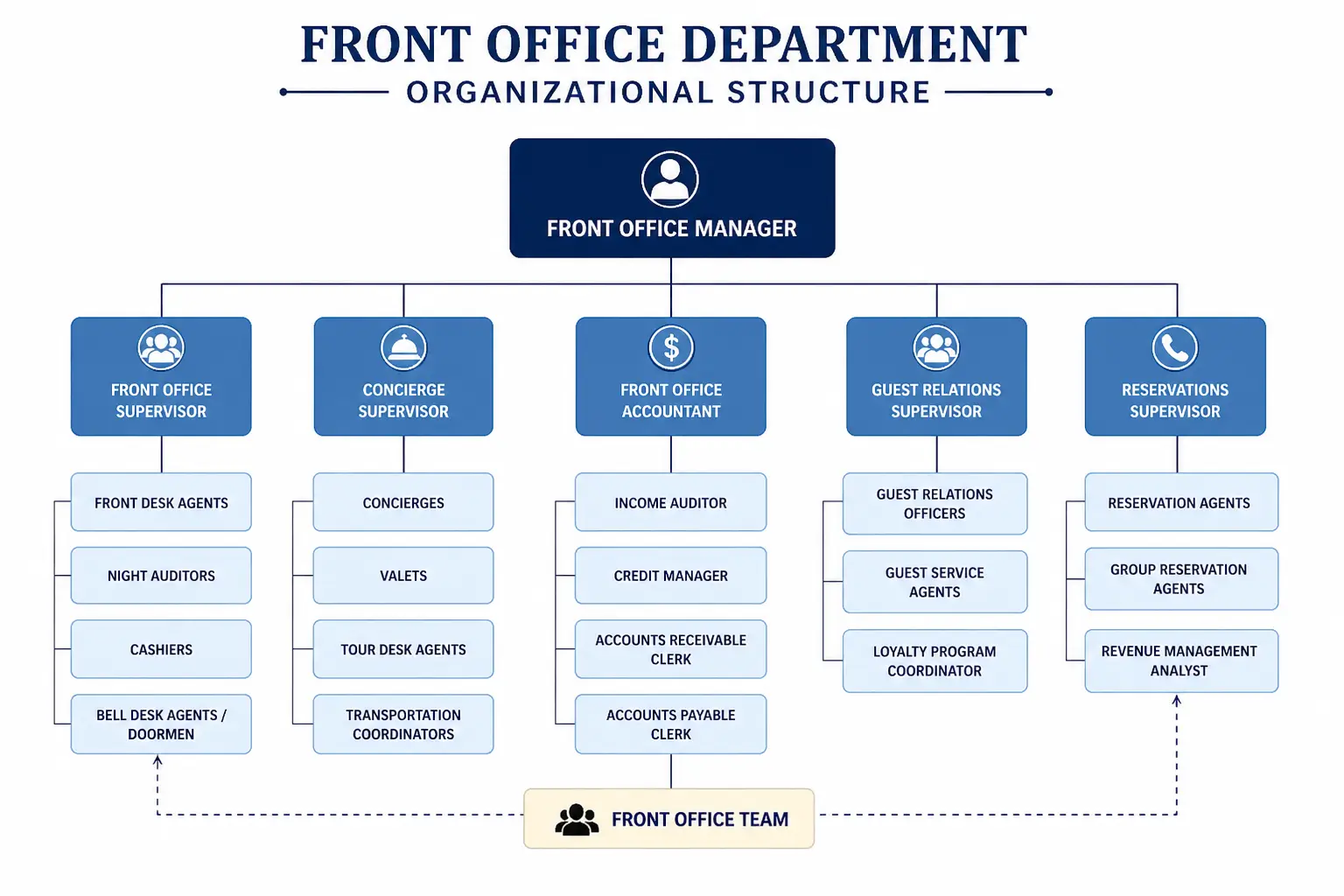
At the top of the hierarchy is the Front Office Manager, who is responsible for overall planning and decision-making. Below the manager are assistant managers, supervisors, and operational staff who handle daily activities.
This hierarchy helps in dividing work effectively. For example, managers focus on planning and strategy, while front desk agents focus on guest interaction. This division ensures that all tasks are handled efficiently.
In large hotels, the structure is more detailed and includes multiple layers of management. In smaller hotels, the structure is simpler but still follows the same basic principles.
The hierarchical structure is important because it ensures accountability. Every employee knows their role and whom they should report to. This reduces confusion and improves service quality.
Organizational Chart of Front Office Department
An organizational chart is a visual representation of the structure of the front office department. It shows the different positions and how they are connected.
Typically, the chart starts with the Front Office Manager at the top, followed by Assistant Managers, Duty Managers, Supervisors, and then operational staff like receptionists, concierge, and bell desk staff.
The chart helps in understanding reporting relationships. For example, receptionists report to the front desk supervisor, who in turn reports to the assistant manager.
This type of chart is very useful for training new employees because it helps them understand the structure quickly. It also helps management in planning and decision-making.
Different hotels may have different charts based on their size and operations. However, the basic structure remains similar across the industry.
Key Functions of Each Unit in the Structure
The front office department is divided into different units, each performing specific functions. These units work together to provide smooth and efficient service.
1. Reservation Unit
This unit handles all booking-related activities. It manages room availability, confirms reservations, and updates the system. It also coordinates with online booking platforms. The reservation unit is important because it directly affects hotel revenue.
2. Reception Unit
The reception is the main contact point for guests. It handles check-in, check-out, and guest inquiries. Reception staff must have good communication skills and a friendly attitude.
3. Concierge Services
The concierge provides personalized services such as booking taxis, arranging tours, and recommending local attractions. This service enhances the guest experience.
4. Bell Desk
The bell desk staff assist guests with luggage and escort them to their rooms. They also provide basic information about the hotel.
5. Communication Center
This unit manages phone calls, emails, and internal communication. It ensures smooth coordination between departments.
All these units must work together to ensure that guests receive seamless service.
Importance of a Well-Defined Organizational Structure
A well-defined organizational structure is essential for the success of the front office department. It helps in improving efficiency, reducing errors, and enhancing guest satisfaction.
When roles and responsibilities are clearly defined, employees can perform their tasks more effectively. This reduces confusion and improves productivity.
According to industry reports, hotels with a well-organized front office structure experience up to 30% higher guest satisfaction rates compared to those without proper structure.
The structure also helps in training new employees. It provides a clear framework for understanding roles and responsibilities.
Another important benefit is better communication. When everyone knows their reporting line, information flows smoothly within the department.
Overall, a strong organizational structure is key to delivering high-quality service and achieving business success.
Factors Affecting Front Office Organizational Structure
Several factors influence how the front office department is structured in a hotel.
1. Hotel Size
Larger hotels require more staff and a detailed structure, while smaller hotels have simpler structures.
2. Type of Hotel
Luxury hotels have more specialized roles compared to budget hotels.
3. Technology
Modern hotels use advanced systems like Property Management Systems (PMS), which affect the structure.
4. Guest Expectations
Higher guest expectations require more staff and better organization.
5. Location
Hotels in tourist areas may need additional services like concierge and travel assistance.
6. Ownership Type
Chain hotels follow standardized structures, while independent hotels have flexible structures.
7. Service Level
Hotels offering premium services require more staff and specialized roles.
8. Seasonality
Hotels with seasonal demand may adjust their structure based on occupancy.
9. Budget
Financial resources affect the number of staff and roles.
10. Management Style
Different management approaches influence how the department is organized.
Each of these factors plays a significant role in shaping the front office structure.
Modern Trends in Front Office Structure
The front office department is evolving with new technologies and changing guest expectations.
One major trend is automation. Many hotels now use self-check-in kiosks and mobile apps to reduce waiting time. According to reports, around 60% of travelers prefer digital check-in options.
Another trend is the use of Property Management Systems (PMS), which help in managing reservations, billing, and guest data efficiently.
Hotels are also adopting multi-skilled staff roles, where employees handle multiple tasks. This improves efficiency and reduces costs.
Digital concierge services are becoming popular, allowing guests to request services through mobile apps.
These trends are changing the traditional front office structure and making it more flexible and technology-driven.
Challenges in Managing Front Office Structure
Managing the front office structure comes with several challenges.
One major challenge is handling peak hours, when many guests arrive or check out at the same time. This can lead to delays and stress for staff.
Another challenge is maintaining service quality. Staff must consistently provide excellent service, even during busy periods.
Communication issues can also arise, especially in large hotels with many employees.
Handling guest complaints is another critical challenge. Staff must resolve issues quickly and professionally.
Staff training and retention are also important challenges, as the front office requires skilled and experienced employees.
Overcoming these challenges requires proper planning, training, and management.
Conclusion
The front office department organizational structure is a crucial part of hotel operations. It ensures that all tasks are performed efficiently and that guests receive high-quality service.
A well-defined structure helps in improving communication, reducing errors, and enhancing guest satisfaction. It also supports employee training and development.
With the rise of technology and changing guest expectations, the front office structure is evolving. Hotels must adapt to these changes to remain competitive.
In conclusion, a strong and well-organized front office department is essential for the success of any hotel. It not only improves operations but also creates a positive and memorable experience for guests.
FAQs
1. What is the main role of the front office department?
The main role is to interact with guests, manage reservations, and ensure a smooth check-in and check-out process.
2. Why is organizational structure important in the front office?
It helps in defining roles, improving efficiency, and ensuring better service.
3. Who is the head of the front office department?
The Front Office Manager is the head of the department.
4. What are the key units of the front office?
Reservation, reception, concierge, bell desk, and communication center.
5. How is technology changing the front office structure?
Technology is introducing automation, digital services, and multi-skilled roles, making operations more efficient.