
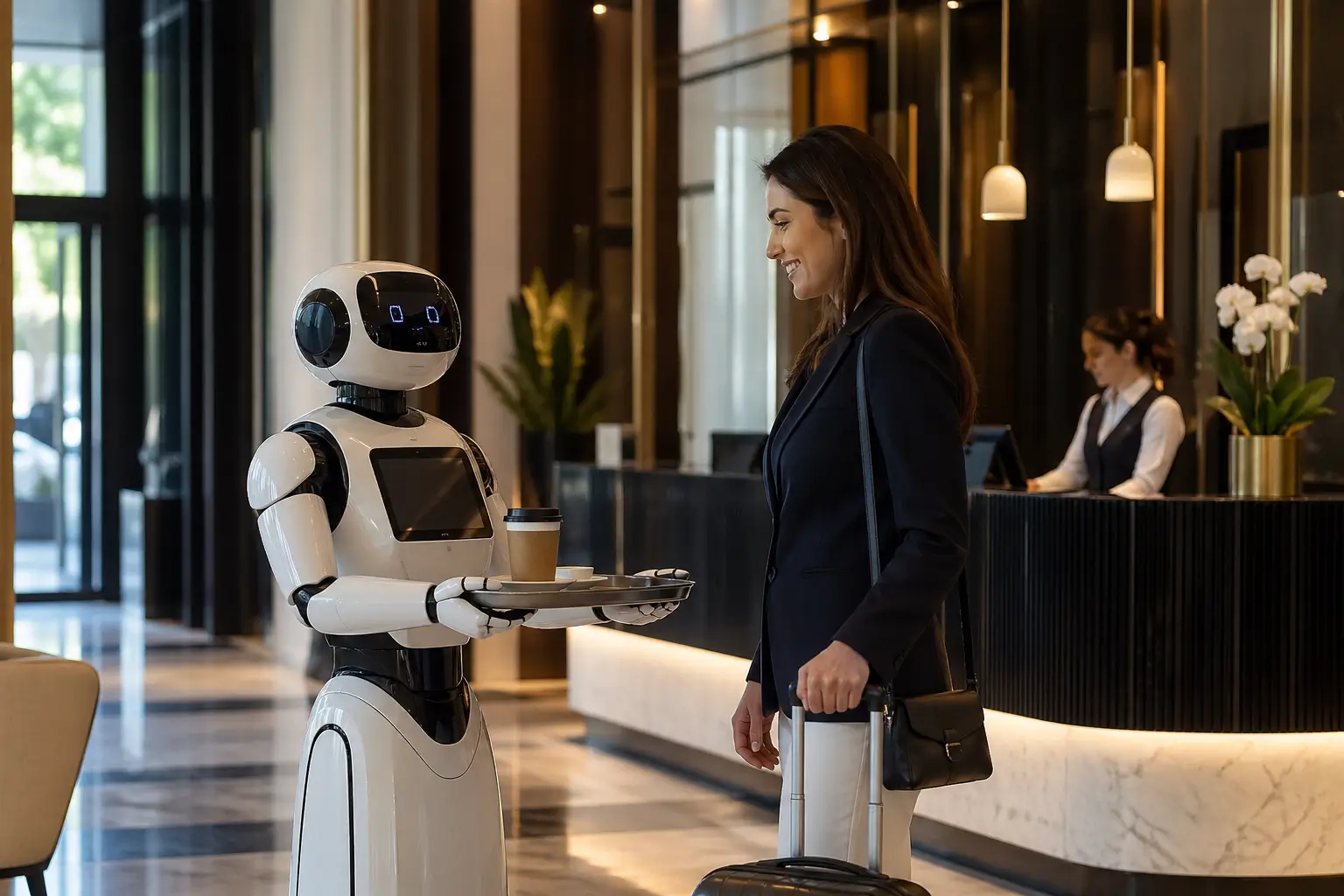
Walk into a hotel lobby today and you might not see a robot rolling your luggage — but there is something invisible working behind the scenes. It is smarter than your front desk manager. It never sleeps. And it is reshaping the entire guest experience from the moment you search “best hotel near me” to the second you check out.
That something is artificial intelligence.
The hospitality industry — l’industrie hôtelière in French — has always been about people serving people. Warm greetings. Handwritten notes. A room that feels like it was made just for you. For decades, the magic of hospitality lived in those human touches. But technology, and especially AI, has now entered this space with a promise that is hard to ignore: what if you could deliver a deeply personal experience at massive scale, to thousands of guests, simultaneously, without error?
That is exactly what AI is beginning to deliver.
In this article, I am going to take you through the full story — what AI means in the context of hospitality, how it is already being used right now, what effects it is having on staff, guests, costs, and the future of the industry, and what questions hoteliers and restaurateurs are still grappling with. This is not a surface-level overview. We are going deep.
What AI Actually Means in Hospitality — The Définition
Before anything else, let us be clear about what we mean by artificial intelligence here. AI, at its core, is the simulation of human cognitive functions — learning, reasoning, problem-solving, and understanding language — by machines. In hospitality, this does not mean robots replacing your chef. It means software that can analyze data, predict behavior, respond to queries, optimize pricing, and personalize service in real time.
There are several branches of AI being deployed in this industry. Machine learning allows systems to learn from historical data to make better predictions. Natural language processing (NLP) powers chatbots and voice assistants. Computer vision is used in security cameras that recognize faces or monitor kitchen hygiene. Predictive analytics helps revenue managers forecast demand.
The global AI in hospitality market was valued at approximately $1.2 billion in 2022. By 2031, analysts expect it to exceed $11 billion — a compound annual growth rate of over 26%. These are not speculative numbers. They reflect ongoing real-world deployment by major players like Marriott, Hilton, Accor, and thousands of independent properties worldwide.
AI entered hospitality gradually — first through revenue management software in the 1990s, then through online booking algorithms, then recommendation engines, and now through full conversational AI and autonomous operations. Today, it touches almost every function in the industry.
Personalisation at Scale — La Personnalisation
One of the oldest principles in hospitality is knowing your guest. A great concierge remembers that Mr. Kim always wants extra pillows and a room away from the elevator. A skilled sommelier remembers you prefer a Burgundy over a Bordeaux. This kind of attention personnalisée has always been a competitive advantage, but it has also been deeply labor-intensive and impossible to scale.
AI changes that equation entirely.
Modern hospitality AI systems can now build and continuously update individual guest profiles that track everything — room preferences, dining habits, previous complaints, loyalty tier, average spend per visit, activities booked, even the time of day they usually check in. This is not intrusive data mining for its own sake. When used responsibly and transparently, it allows properties to deliver experiences that feel genuinely tailored.
According to a 2023 study by Salesforce, 73% of customers expect companies to understand their unique needs and expectations. In hospitality, that expectation is even higher. A guest spending $500 a night expects to be recognized. AI makes it possible to recognize that guest not just at one property, but across an entire global chain.
Consider what this looks like in practice. A returning guest at a Hilton property in Tokyo checks in online. The AI system, recognizing her profile, pre-assigns her a room on a high floor away from the ice machine — something she complained about two stays ago. It sends her a mobile key, a welcome message mentioning her preferred newspaper, and a dining recommendation tailored to her dietary preferences logged during her last stay. None of this required a human to review her file. The AI handled it in milliseconds.
That is what personalization at scale looks like, and it is only getting more sophisticated.
AI-Powered Revenue Management — La Gestion des Revenus
Revenue management is one of the oldest applications of technology in hospitality, and AI has pushed it to extraordinary new levels. Traditional revenue management relied on historical occupancy data and manual adjustments by experienced managers. Today, AI-driven systems process thousands of data points per minute — competitor pricing, local events, weather forecasts, search demand on booking platforms, flight arrival data, even social media sentiment — and adjust room rates dynamically in real time.
The industry term for this is dynamic pricing or intelligent revenue optimization, and the results are striking. Hotels using advanced AI revenue management systems have reported RevPAR (Revenue Per Available Room) improvements of 10–15% on average compared to manual processes. For a 200-room property averaging $150 per night, that is an additional $450,000 or more in annual revenue.
Companies like IDeaS, Duetto, and Atomize have built entire platforms around this capability. These systems do not just react to current demand — they predict future demand weeks or months in advance and suggest inventory allocation strategies that maximize yield across room types, segments, and distribution channels.
For restaurant revenue management, AI is being used to optimize table turnover, predict no-shows, manage reservation capacity, and adjust menu pricing based on ingredient cost fluctuations and demand trends. The chef de revenue — the revenue manager — is no longer relying on gut instinct. The data is doing the heavy lifting.
Chatbots and Virtual Concierges — Le Concierge Virtuel
Guest communication used to require a physical front desk, a phone, or a long email chain. Today, AI-powered chatbots and virtual concierges are handling millions of guest interactions daily — before, during, and after the stay.
These are not the clunky FAQ bots of 2010. Modern hospitality chatbots, powered by large language models (LLMs) similar to the technology behind ChatGPT, can hold nuanced, context-aware conversations across WhatsApp, SMS, hotel apps, and website chat. They can make restaurant reservations, arrange airport transfers, explain cancellation policies in multiple languages, handle complaints with emotional intelligence, and escalate complex issues to human staff when needed.
The statistics are compelling. According to Gartner, chatbots are expected to handle 85% of customer service interactions in the hospitality sector by 2025. A 2022 survey found that hotels using AI chatbots saw a 30% reduction in front desk call volume and a 25% increase in upsell conversion from pre-arrival communication.
One remarkable example is Connie, Hilton’s AI concierge robot pilot, built in partnership with IBM Watson. Though the robotic deployment was experimental, the conversational AI backend powering it has since influenced how major chains approach digital guest communication. More practically, Marriott’s ChatBotlr allows guests to make requests via SMS — powered by AI — with a 97% satisfaction rate in early pilots.
What makes these systems valuable is not just availability. It is consistency. A human front desk agent might be distracted, tired, or less knowledgeable on a given day. The AI is always at peak performance, drawing from the full knowledge base of the property, the chain, and the destination.
Housekeeping and Operations Optimization
Behind every great guest experience is an invisible operational machine — housekeeping teams, maintenance crews, supply chain logistics, energy systems. These areas are unglamorous but critical, and AI is having a transformational effect on all of them.
AI-driven housekeeping management systems use predictive models to determine cleaning priority, room turnover time, and staff allocation. Instead of a fixed floor-by-floor cleaning schedule, the system dynamically assigns rooms based on guest check-out data, stay patterns, and real-time requests. This reduces labor waste, cuts average room turnaround time, and ensures priority rooms are ready first.
Predictive maintenance is another powerful application. Hotels are massive mechanical systems — HVAC units, elevators, plumbing, kitchen equipment, laundry machines. Traditional maintenance was either reactive (fix it when it breaks) or preventive (fix it on a schedule). AI enables maintenance prédictive — predicting when equipment is likely to fail based on sensor data, usage patterns, and historical failure rates, then scheduling maintenance before the failure occurs. Hilton has reported reducing HVAC maintenance costs by up to 20% using AI-driven predictive models.
Energy management is equally significant. AI systems now control lighting, heating, and cooling at a granular level — adjusting room temperature based on occupancy sensors, time of day, and outdoor weather. The Wynn Las Vegas reportedly saved $1 million per year in energy costs after deploying AI-driven energy optimization across its 4,700 rooms.
These operational gains are not trivial. For a full-service hotel where labor and energy are the two largest cost lines, even a 10% improvement in efficiency can translate to millions in annual savings.
AI in Food and Beverage — La Restauration Intelligente
The restaurant side of hospitality has its own rich landscape of AI applications, and some of the most interesting innovations are happening here. From kitchen automation to menu engineering to demand forecasting, AI is touching every corner of the F&B operation.
Here are key areas where AI is making a measurable difference in food and beverage:
- Menu optimization: AI analyzes sales data, ingredient costs, preparation time, and customer preferences to identify which menu items should be promoted, repriced, or removed. The practice — sometimes called menu engineering intelligente — helps restaurants maximize per-cover profitability without reducing guest satisfaction.
- Demand forecasting: AI predicts how many covers a restaurant will serve on any given day, accounting for weather, local events, historical trends, and reservation data. This allows chefs to prep the right quantities, reducing food waste dramatically. According to the USDA, food waste in U.S. restaurants amounts to approximately 30–40% of the food supply — AI-driven forecasting can cut that figure significantly.
- Inventory management: Smart AI inventory systems track stock levels in real time, automatically generate purchase orders, flag expiring ingredients, and suggest recipes that use near-expiry items. This directly reduces food cost percentages.
- Recipe standardization and consistency: In large hotel F&B operations serving hundreds of covers daily, AI-assisted kitchen management systems help maintain recipe consistency across multiple outlets and shifts.
- Personalized dining recommendations: AI analyzes guest dietary preferences, allergies, past orders, and occasion data to recommend dishes or wine pairings proactively. Some upscale properties now present personalized digital menus generated in real time.
- Automated ordering and payment: Tablet-based and QR code ordering systems powered by AI streamline the ordering process, reduce server errors, and increase table turn speed.
- Beverage program management: AI tools help bar managers track spirits inventory, flag overpouring, and optimize cocktail menu profitability.
- Kitchen workflow management: AI analyzes ticket flow and station capacity to minimize bottlenecks during peak service — a kind of digital chef de partie coordinating the brigade.
- Guest feedback analysis: NLP tools scan review platforms, post-dining surveys, and social media to extract specific F&B sentiment — identifying patterns in complaints about a particular dish or praising a specific server.
- Dynamic pricing for dining: Similar to hotel room rates, some restaurants now experiment with AI-driven pricing — charging more during peak hours or special events, and offering incentives during slower periods to fill tables.
Each of these applications, taken individually, delivers incremental gains. Together, they compound into a meaningfully more profitable and consistent F&B operation.
The Effect of AI on Hospitality Staff — Le Personnel
This is the conversation that makes many hospitality workers nervous, and it deserves an honest, nuanced treatment.
AI is undeniably automating tasks that humans previously performed. Self-check-in kiosks are reducing the need for traditional front desk agents in budget and midscale properties. Chatbots are handling queries that once required a night audit team. Automated housekeeping scheduling is reducing the role of the floor supervisor. Revenue management AI is doing in seconds what a team of analysts once did over days.
But the picture is more complex than simple job replacement.
A 2023 McKinsey report found that while AI will automate significant portions of hospitality work, the nature of that disruption is more about task displacement than full job elimination in the luxury and full-service segment. The front desk agent whose job no longer includes handing out key cards has more time to spend on genuine hospitality — engaging with guests, solving problems, building loyalty. The revenue manager who no longer manually builds rate grids can focus on strategy, partnerships, and creative packaging.
The real risk is in lower-wage, task-heavy roles at budget properties and quick-service restaurants. Here, automation pressure is genuine and growing. Self-service kiosks at McDonald’s and Shake Shack have demonstrably reduced front-of-house headcount.
For the industry overall, the solution lies in reskilling — upskilling hospitality workers to manage, interpret, and work alongside AI systems rather than compete against them. The most valuable hospitality professional of the coming decade will not be the one who can perform a task the fastest, but the one who can read a room, build trust, and deliver the kind of human warmth that no algorithm can replicate.
Guest Experience Transformation — L’Expérience Client
At the end of every AI deployment in hospitality, the true measure of success is the guest experience. Does the guest feel better served? Does the property feel more attentive, more personal, more seamless?
Evidence suggests that when AI is deployed thoughtfully, the answer is yes.
A 2023 Oracle Hospitality survey of 5,000 travelers found that 73% were comfortable with AI being used to improve their experience — as long as their personal data was protected and human staff remained accessible. Notably, 49% said they would actually prefer to interact with AI for transactional requests (check-in, requests, information) so they could reserve human interaction for genuine hospitality moments.
The rise of the expérience sans friction — the frictionless experience — is one of AI’s most impactful contributions to guest satisfaction. Guests no longer need to wait in queues, repeat information at every touchpoint, or call the front desk for basic requests. Mobile keys, AI messaging, automated pre-arrival personalization, and smart room controls all contribute to a stay that flows smoothly and feels effortless.
Luxury properties are using AI differently — not to replace staff, but to make their staff more informed and more attentive. When a butler at a Five-Star property receives a real-time alert that a VIP guest who mentioned celebrating her anniversary at check-in has been in the restaurant for two hours, the AI is not intruding — it is enabling a perfectly timed champagne surprise that will create a memory for life.
That is the highest potential of AI in hospitality: not efficiency alone, but the elevation of human connection.
Challenges, Ethics, and the Road Ahead — Les Défis
No technology arrives without complications, and AI in hospitality is no exception.
Data privacy is the most significant concern. AI personalization depends entirely on guest data — and collecting, storing, and using that data responsibly is both a legal obligation under frameworks like GDPR and CCPA, and an ethical imperative. Hotels that fail to protect guest data or that use it in ways guests have not consented to will face regulatory penalties and a collapse in guest trust.
Algorithmic bias is a less-discussed but real issue. If an AI system is trained on historical data that reflects past discriminatory practices — like charging more for rooms during events in certain neighborhoods — it can perpetuate those patterns at scale without any human ever making a conscious discriminatory decision.
Technology adoption costs are substantial. Implementing enterprise AI across a large hotel requires investment in software, hardware, staff training, data infrastructure, and change management. For independent properties and small groups, the upfront cost can be prohibitive without the right financing or phased approach.
Then there is the question of the soul of hospitality. Too much automation in the wrong places can make a property feel sterile and transactional. A hotel that has replaced every human touchpoint with a screen has missed the point of what hospitality fundamentally is. The most successful deployments will always keep the human at the center, with AI as the enabler — not the replacement — of genuine connection.
Conclusion: Checking Into the Future
AI is not a distant future for the hospitality industry. It is happening right now, at scale, across the entire guest journey. From the moment a traveler searches for a hotel to the moment they leave a review, AI is shaping the experience, optimizing the economics, and redefining what is possible.
The properties that will thrive are the ones that treat AI not as a cost-cutting tool but as an amplifier of their human culture. The goal has never changed — it is still about making people feel welcome, valued, and cared for. AI, at its best, simply makes it possible to do that better, faster, and for more people than ever before.
The industry stands at a genuine inflection point. The choices made in the next five years — about how AI is deployed, who benefits, and what values guide its use — will determine whether this technology deepens or diminishes the art of hospitality.
I believe it will deepen it. But only if we stay intentional.
Frequently Asked Questions
1. How is AI being used in the hotel industry today? AI is currently being used in hotels for dynamic room pricing, personalized guest communication through chatbots, predictive maintenance of equipment, housekeeping optimization, energy management, and guest profile personalization. Major chains like Hilton and Marriott have deployed AI across multiple operational functions, with measurable improvements in revenue, efficiency, and guest satisfaction scores.
2. Will AI replace hotel and hospitality workers? AI will automate many task-level functions in hospitality, particularly in budget and transactional segments. However, in full-service and luxury properties, AI is more likely to augment human roles than eliminate them — freeing staff from repetitive tasks to focus on genuine guest connection and complex problem-solving. The key challenge is reskilling workers to collaborate effectively with AI-driven systems.
3. How does AI improve the guest experience in hotels? AI improves guest experience through seamless personalization, frictionless check-in and check-out, proactive service anticipation, real-time communication via chatbots, smart room customization, and faster problem resolution. Studies show that guests increasingly prefer AI for transactional interactions, reserving human contact for meaningful hospitality moments.
4. What are the risks of using AI in the hospitality industry? Key risks include data privacy breaches and GDPR/CCPA non-compliance, algorithmic bias in pricing and service delivery, high implementation costs for smaller properties, over-automation that strips away the human warmth central to hospitality, and staff resistance without proper change management and training programs in place.
5. What is the future of AI in the hospitality industry? The AI in hospitality market is projected to grow from approximately $1.2 billion in 2022 to over $11 billion by 2031. Future developments include fully autonomous check-in and check-out systems, voice-controlled smart rooms, AI-driven concierge services rivaling human expertise, hyper-personalized dining experiences, and real-time emotion recognition to proactively address guest dissatisfaction before it escalates.