
I remember watching old footage of Neil Armstrong stepping on the moon and thinking — that world belongs to astronauts, not to people like me. That feeling stayed with me for years. But something shifted in the last decade. Space stopped being a government secret and started becoming a destination. A real one. With tickets, waiting lists, and yes — price tags that would make your jaw drop.
Space tourism, or le tourisme spatial as the French call it, is no longer science fiction. It is a growing, billion-dollar industry reshaping how humanity thinks about travel, adventure, and what it means to be alive on this planet. The global space tourism market was valued at approximately $848 million in 2023 and is projected to reach over $8 billion by 2030. Those are not small numbers. That is a revolution happening in slow motion above our heads.
In this article, I am going to break down everything — the history, the players, the science, the costs, the risks, and what the future actually looks like for ordinary people who want to leave Earth, even just for a few minutes.
What Exactly Is Space Tourism? Defining Le Tourisme Spatial
Space tourism is the practice of traveling into outer space for recreational, leisure, or commercial purposes — not for scientific research or national defense. The word “tourism” here carries weight. It implies choice, pleasure, and personal experience rather than duty or mission.
The term became mainstream in 2001 when American businessman Dennis Tito paid approximately $20 million to travel aboard a Russian Soyuz spacecraft to the International Space Station. He stayed there for nearly eight days. He was not a trained cosmonaut. He was a paying customer. That single event cracked open a door that governments had kept locked for decades.
There are three recognized categories of space tourism. Suborbital tourism takes you to the edge of space — roughly 100 kilometers above Earth, known as the Kármán line — and brings you back within minutes. You experience weightlessness briefly and see the curvature of the planet. Orbital tourism means actually circling Earth, spending days or weeks in microgravity. Lunar and deep-space tourism is still largely theoretical but actively being planned by multiple companies.
The industry sits at a fascinating crossroads between luxury travel, extreme adventure, and genuine scientific frontier.
The History of Space Tourism: From Cold War Rockets to Private Launchpads
Space exploration began as a geopolitical chess match. The Soviet Union launched Sputnik in 1957. The United States responded with NASA in 1958. The entire enterprise was about national pride, military advantage, and technological dominance. Civilians were spectators, not participants.
The shift began quietly in the 1990s. In 1996, the X Prize Foundation announced a $10 million prize for the first non-government team to reach space twice within two weeks using a reusable spacecraft. Scaled Composites won it in 2004 with SpaceShipOne. That moment told the world that private companies could do what governments had monopolized for fifty years.
Then came Dennis Tito in 2001, followed by South African entrepreneur Mark Shuttleworth in 2002, American businessman Gregory Olsen in 2005, and a handful of others through a company called Space Adventures working with Russia’s Roscosmos. These early pioneers paid between $20 million and $40 million each for the privilege. They trained for months. They accepted extraordinary risk. And they proved that civilian bodies could survive and thrive beyond Earth’s atmosphere.
By the 2010s, Elon Musk’s SpaceX, Jeff Bezos’s Blue Origin, and Richard Branson’s Virgin Galactic had entered the picture — each with a different vision, a different rocket, and a different idea of who should get to go.
The Major Players: Companies Competing for the Stars
The commercial space race today looks nothing like the Cold War one. It is noisier, messier, more entrepreneurial, and frankly more exciting. Several companies are currently leading the charge, and each one deserves a close look.
SpaceX launched its first all-civilian mission, Inspiration4, in September 2021 — four non-professional astronauts orbiting Earth for three days. No government astronaut on board. Pure civilian spaceflight. The company also offers seats on its Crew Dragon capsule through private arrangements. SpaceX’s Starship program, still in development, aims to carry passengers to the Moon and eventually Mars.
Blue Origin runs its New Shepard vehicle for suborbital tourism. Jeff Bezos himself flew on the first crewed flight in July 2021. The capsule takes passengers just past the Kármán line, offers roughly eleven minutes of weightlessness, and lands itself via parachute. Tickets were initially auctioned for millions but have reportedly come down significantly.
Virgin Galactic uses a unique air-launch system — a mothership carries the spacecraft to high altitude before releasing it. The VSS Unity reached space in 2021. Richard Branson flew aboard it in July of that year, just days before Bezos. Virgin Galactic has been selling tickets since 2004, originally at $250,000 per seat.
Axiom Space is building the world’s first private space station and has already launched commercial crews to the ISS. Their model is closest to traditional orbital tourism — full missions, serious training, and multi-day stays.
Space Adventures remains the only company to have sent private individuals to the ISS aboard Soyuz spacecraft — a track record spanning two decades.
The Experience Itself: What Actually Happens When You Go to Space
Let me paint you a picture of what a suborbital flight actually feels like, based on accounts from people who have done it.
You strap in. The acceleration hits you hard — roughly three to four times the force of gravity pressing your body into the seat. Your vision narrows. Then suddenly the engine cuts. Silence. And you float.
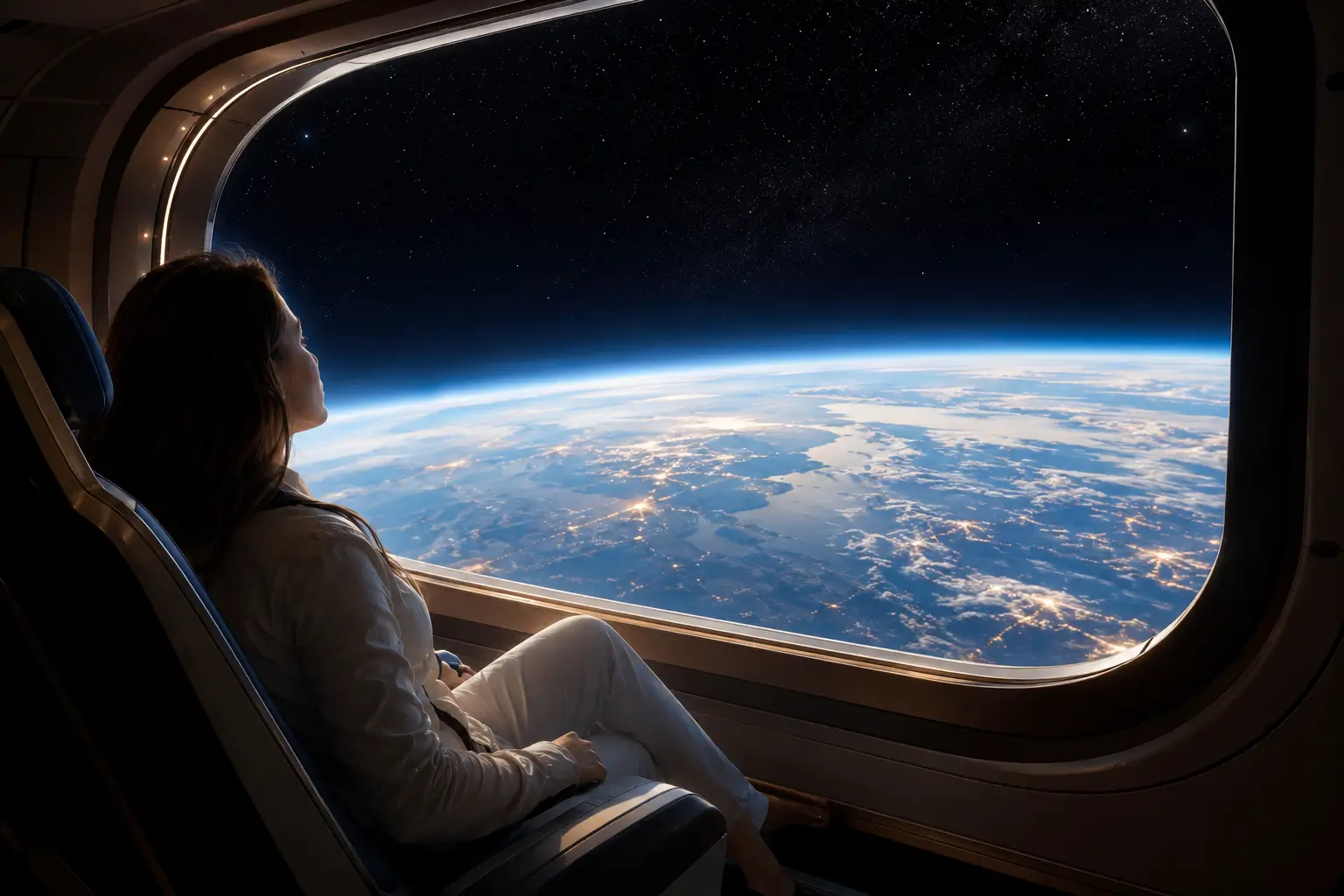
Weightlessness is not what most people expect. Your body does not feel light — it feels absent. Fluids shift toward your head. Your face puffs slightly. Objects drift. You drift. You look out the window and see the curvature of Earth, the razor-thin blue line of the atmosphere, and the absolute black of space beyond it. Astronauts call this the vue de l’aperçu — the overview effect. A profound psychological shift in how you understand your place in the universe.
It lasts minutes for suborbital passengers. Days for orbital ones. But nearly every person who has experienced it reports a fundamental change in perspective. Climate change feels more real when you can see how thin the atmosphere is. National borders feel absurd when they do not exist from up there. The planet looks simultaneously enormous and terrifyingly fragile.
Reentry brings the gravity back hard. Landing follows. And then you are standing on solid ground, trying to explain something words were not built to describe.
The Cost of a Ticket: Who Can Actually Afford This?
Here is the uncomfortable truth: space tourism is, right now, a billionaire’s playground. But the economics are changing faster than most people realize.
A seat on a Blue Origin New Shepard flight reportedly costs between $450,000 and $500,000 currently. Virgin Galactic seats were originally $250,000, then raised to $450,000 after demand surged following their crewed flights. A full orbital mission through SpaceX or Axiom Space can cost upward of $50 million per person, covering training, equipment, and mission operations.
But here is the historical parallel that matters: the first commercial airline ticket in 1914 cost $400, which is approximately $12,000 in today’s money. By the 1970s, a transatlantic flight cost around $550 in today’s dollars. By 2024, you can fly London to New York for under $400. Technology commoditizes. Scale reduces cost. Space will follow the same curve — just compressed into decades rather than centuries.
Analysts at Morgan Stanley projected that the space economy could exceed $1 trillion by 2040. A significant portion of that revenue is expected from tourism. Reusable rockets — SpaceX’s Falcon 9 has been launched and landed over 200 times — are already slashing per-flight costs dramatically.
The Risks: What Nobody Talks About Enough
I want to be honest here because the marketing materials never quite are. Space travel is dangerous. Not commercially-airline dangerous. Genuinely, historically dangerous.
The Space Shuttle had a 1.5% failure rate per mission. Early Soyuz missions had similar risks. Modern systems are better, but the physics of putting a human body into space and bringing it back have not fundamentally changed. Rocket fuels are explosive. Reentry generates temperatures exceeding 1,600 degrees Celsius. Even minor structural failures can be catastrophic.
The human body itself struggles. Cosmic radiation exposure increases cancer risk. Microgravity causes bone density loss at roughly 1% per month. Muscle atrophy accelerates. Vision problems — specifically intracranial pressure changes — have been documented in astronauts after extended stays. For short suborbital hops, these risks are minimal. For multi-week orbital stays, they are genuine medical considerations.
Then there is the psychological dimension. Isolation, confinement, and the constant awareness of existing in a vacuum separated from you by a few centimeters of metal hull — these create unique mental pressures that space medicine is only beginning to fully understand.
None of this means space tourism is irresponsible. Every transformative form of travel in human history carried risk. But informed travelers deserve to know what they are accepting.
The Environmental Question: Space Tourism’s Carbon Problem
This conversation is happening loudly within the aerospace industry and I think it deserves direct engagement. Rocket launches are not clean events.
A single SpaceX Falcon 9 launch burns approximately 140,000 pounds of kerosene-based fuel. Blue Origin’s New Shepard uses liquid hydrogen and liquid oxygen — producing water vapor rather than CO₂, which sounds cleaner but water vapor at high altitudes has complex warming effects that scientists are still quantifying. Virgin Galactic’s SpaceShipTwo hybrid engine releases black carbon — soot — directly into the stratosphere where it can persist for years.
A 2022 study published in a major atmospheric science journal found that rocket launches emit significantly more warming substances per passenger kilometer than any other form of transportation, including private jets. The comparison is stark: a transatlantic flight emits roughly 0.5 tons of CO₂ per passenger. A suborbital space tourism flight emits the equivalent of several tons per passenger.
The industry is aware of this. Methane-based engines like SpaceX’s Raptor engines used in Starship burn cleaner than kerosene. Green hydrogen propulsion is being explored. But until renewable-fueled rockets become standard, space tourism carries a serious environmental cost that wealthier passengers are largely absorbing and the rest of the world is partly paying for.
Conclusion: The Dawn of L’Ère du Tourisme Spatial
We are living at the beginning of something that will look, in a hundred years, like the moment the first steamship crossed the Atlantic or the first commercial airplane carried paying passengers. The ère du tourisme spatial — the era of space tourism — is not arriving. It has arrived. Quietly, expensively, and with enormous implications.
I believe this industry will eventually democratize. I believe a generation of children alive today will take suborbital flights the way my generation takes intercontinental ones. I believe the overview effect — that shift in consciousness that happens when you see Earth from above — will eventually be accessible to people who are not millionaires.
But right now, in 2025, the honest assessment is this: space tourism is a frontier industry with extraordinary promise, meaningful risks, legitimate environmental concerns, and a small but growing population of humans who have actually done it and come back changed.
The sky is no longer the limit. It never really was.
FAQ: Space Tourism — High Search Volume Questions Answered
1. How much does a space tourism ticket cost in 2025? Costs vary by experience type. Suborbital flights with Blue Origin or Virgin Galactic range from approximately $450,000 to $500,000 per seat. Full orbital missions through SpaceX or Axiom Space cost between $50 million and $55 million per person, covering training and mission costs. Prices are expected to drop significantly as reusable technology matures and competition increases among providers.
2. Is space tourism safe for ordinary people? Modern commercial spacecraft are designed with civilian passengers in mind, not trained astronauts. Companies run rigorous safety protocols and pre-flight health screenings. Suborbital flights carry lower risk than orbital ones due to shorter exposure and simpler trajectories. However, all spaceflight carries inherent risk that exceeds conventional aviation. Passengers sign detailed waivers and undergo medical evaluations before being approved.
3. Who were the first space tourists in history? Dennis Tito, an American businessman and former NASA engineer, became the world’s first recognized space tourist in April 2001 when he traveled to the International Space Station aboard a Russian Soyuz spacecraft, paying approximately $20 million. He was followed by Mark Shuttleworth in 2002 and several others through the 2000s, all arranged through Space Adventures in partnership with Russia’s Roscosmos.
4. What companies offer space tourism flights right now? The main active providers currently include Blue Origin with its New Shepard vehicle for suborbital trips, Virgin Galactic with its SpaceShipTwo for suborbital experiences, SpaceX offering orbital missions through its Crew Dragon capsule, and Axiom Space providing private orbital stays aboard the ISS. Space Adventures continues to broker missions via Russian partnerships. Several other companies including Sierra Space and Vast are developing future offerings.
5. What does weightlessness feel like during a space tourism flight? Passengers describe the sensation as profoundly disorienting at first — not a feeling of lightness but of absence of direction. Fluids shift toward the head, faces puff slightly, and all sense of up or down disappears. Objects and people float freely. Most passengers report it as the most surreal physical experience of their lives. For suborbital flights, weightlessness lasts approximately four to six minutes. The experience is often described using the French term l’apesanteur — a state of non-weight that language struggles to fully capture.