
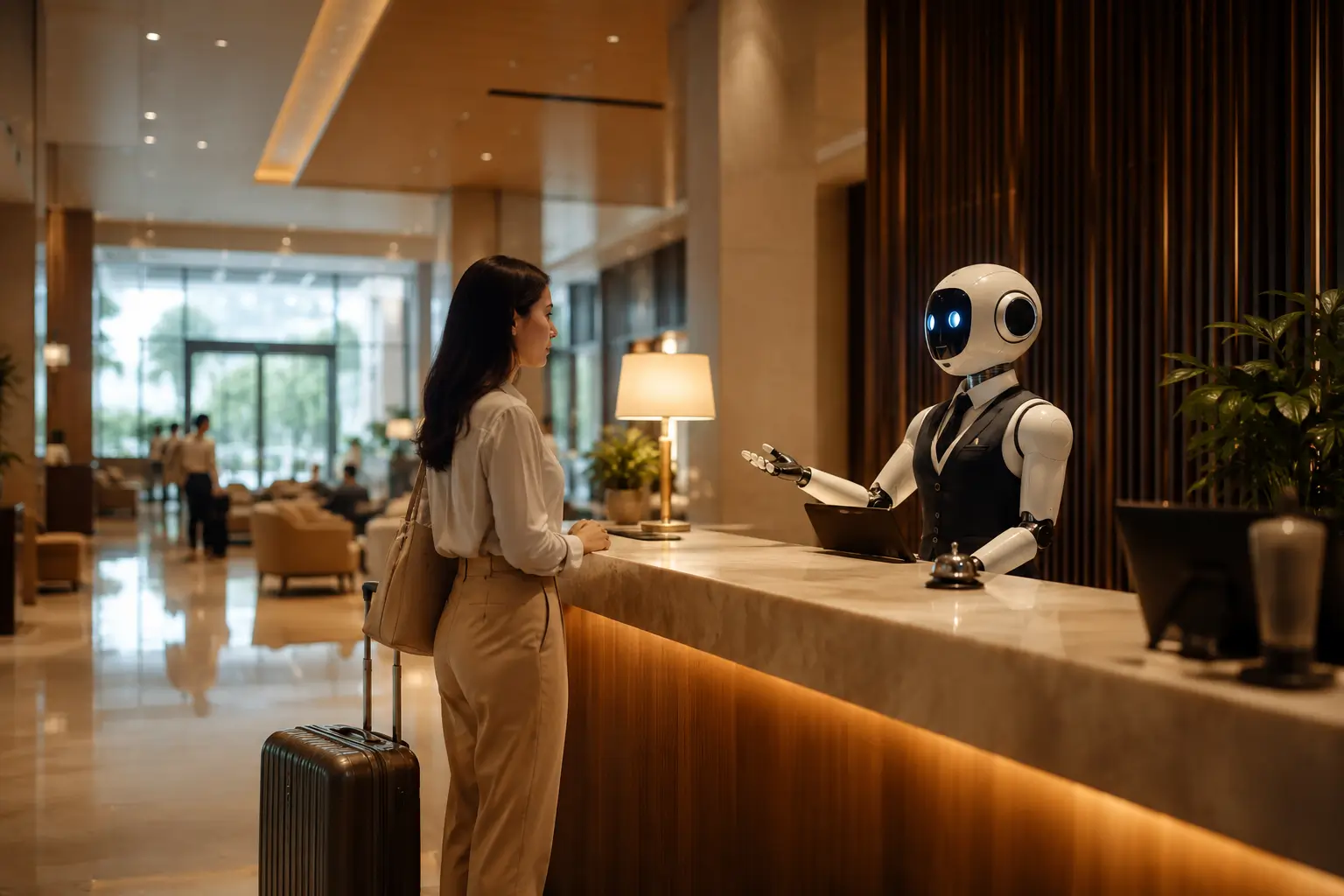
I remember walking into a five-star hotel in Dubai three years ago and being greeted — not by a concierge in a suit — but by a sleek tablet mounted on a marble counter, asking me to check in by scanning my passport. There was no queue. No awkward small talk. Just clean, fast, and seamless service. That was my first real brush with AI in hospitality, and honestly, it shook me.
The hotel industry — one of the oldest service industries on the planet — is going through its most dramatic transformation since the invention of the elevator. Artificial Intelligence, or what the French call intelligence artificielle, is no longer a futuristic concept reserved for tech companies. It has quietly moved into the lobby, the kitchen, the boardroom, and even the bed linen supply chain.
According to a 2023 report by Skift and Oracle Hospitality, over 73% of hotel executives believe AI will be the single biggest disruptor to their industry in the next five years. And they are not wrong. From personalised guest experiences to revenue management algorithms that update room prices every 15 minutes, AI is changing everything.
I am going to walk you through exactly how this is happening — department by department, problem by problem — with real numbers, real context, and no fluff.
What Exactly Is AI in the Context of Hotels?
Before we go deeper, let us define what we are actually talking about. Artificial Intelligence, a term first formally coined by American computer scientist John McCarthy in 1956 at the Dartmouth Conference, refers to machines or software systems that simulate human cognitive functions — learning, reasoning, problem-solving, perception, and language understanding.
In the hotel world, AI does not mean robots doing backflips in the lobby (though some properties in Japan have tried that). It means software systems that analyse vast amounts of data, learn from patterns, and make intelligent decisions — often faster and more accurately than any human team could.
The écosystème technologique hôtelier — the technological ecosystem of hotels — now includes machine learning algorithms, natural language processing chatbots, computer vision systems, predictive analytics engines, and robotic process automation tools. These are not novelty features. They are operational necessities for any hotel competing at scale in 2024 and beyond.
The global AI in hospitality market was valued at approximately USD 4.1 billion in 2023 and is projected to reach USD 21.9 billion by 2031, growing at a compound annual growth rate of 23.4%. That number alone tells you this is not a passing trend.
The Guest Experience Revolution: Personalisation at Scale
If there is one area where AI has made the most visible and emotionally significant impact, it is in the expérience client — the guest experience. Hotels have always known that personalisation drives loyalty. But doing it at scale — for 400 rooms, 12,000 annual guests, and dozens of different guest profiles — was humanly impossible. Until now.
Modern AI systems pull data from booking history, past preferences, dietary requirements, room temperature settings, even the time a guest typically orders room service. They combine this data to build a profil d’invité — a guest profile — that updates in real time throughout each stay. When a returning guest checks in, the system has already pre-set their preferred room temperature, queued their favourite music genre in the app, and flagged to the restaurant that they are lactose intolerant.
The impact of this is measurable. Hotels using AI-driven personalisation report a 20–30% increase in upsell conversion rates and a 15% boost in guest satisfaction scores, according to data from Salesforce’s 2023 State of the Connected Customer report.
Let me walk you through the specific areas where personalisation through AI is reshaping the guest journey:
- Pre-arrival communication: AI systems send automated but deeply personalised pre-arrival emails that go far beyond a generic “We look forward to welcoming you.” They reference the guest’s previous stays, suggest activities based on their stated interests, and offer room upgrades that align with their budget patterns. A guest who booked a standard room but has previously upgraded to a suite gets a targeted, well-timed upgrade offer — not a blanket promotional email.
- Dynamic room assignments: Rather than assigning rooms arbitrarily, AI tools analyse a guest’s preferences — high floor, away from elevator, quiet side of the building — and automatically match them to the most suitable available room. This reduces front desk complaints significantly and makes the guest feel genuinely understood before they even arrive.
- In-stay preferences management: AI systems connected to room automation platforms track whether a guest adjusts their thermostat, dims their lights, or orders the same breakfast three days in a row. By day two, those preferences are applied automatically for the rest of the stay.
- Real-time feedback analysis: Traditionally, hotels collected guest feedback through post-departure surveys that were filled in 72 hours later — when the guest had mostly forgotten the details. AI now analyses in-stay sentiment through app interactions, chatbot conversations, and even voice assistant responses to detect dissatisfaction during the stay and trigger an immediate service recovery action.
- Loyalty programme optimisation: AI engines analyse a member’s entire loyalty programme history — not just their point balance — and identify the most relevant reward offers for each individual. A business traveller who flies in every Tuesday and leaves Thursday gets very different offers than a family that visits once a year during school holidays.
- Concierge recommendation engines: The digital concierge, powered by AI, no longer just lists popular restaurants. It learns what type of cuisine a guest prefers, factors in the current weather, checks real-time restaurant availability through API integrations, and makes genuinely useful recommendations — the kind a well-travelled human concierge would take years to develop.
- Multilingual communication: AI-powered natural language processing allows a hotel to communicate fluently in 50+ languages without a multilingual human team. A Japanese guest making a special request through the hotel app receives a response in natural, contextually appropriate Japanese — not Google Translate gibberish.
- Post-stay re-engagement: After a guest checks out, AI systems calculate the optimal time to send a re-booking incentive based on the guest’s historical booking window. If they typically book two months in advance for summer, the system sends the offer in early April — not in January when it is too early, and not in June when it is too late.
- Amenity usage prediction: AI analyses check-in data, weather forecasts, and historical amenity usage to predict which facilities will be busy and when. The spa team knows to add extra staff on Saturday mornings. The pool bar knows to stock more drinks on hot afternoons. Preparation becomes proactive rather than reactive.
- Birthday and anniversary recognition: This sounds simple, but the execution at scale is not. AI systems cross-reference CRM data with booking dates and automatically trigger a room decoration request, a complimentary dessert, or a personalised note — ensuring that no significant occasion goes unnoticed, even in a 1,000-room resort.
Revenue Management: The Algorithm That Never Sleeps
Revenue management — called gestion des revenus in French — has always been a science in the hotel industry. The concept originated in the airline industry in the 1970s when American Airlines developed yield management systems to dynamically price seats. Hotels adopted similar principles in the 1980s, but for decades, revenue managers were doing this work manually, with spreadsheets, gut instincts, and a lot of coffee.
AI has completely rewired this process. Modern revenue management systems powered by machine learning analyse hundreds of variables simultaneously — market demand signals, competitor pricing, local events, weather patterns, historical booking pace, channel mix, and even search query trends on Google — to adjust room rates dynamically, often multiple times per day.
The results speak clearly. Hotels using AI-driven revenue management systems report an average RevPAR (Revenue Per Available Room) increase of 6–10%, according to IDeaS Revenue Solutions. For a mid-sized hotel generating $10 million in annual room revenue, that is an additional $600,000 to $1 million per year — simply from pricing more intelligently.
The traditional approach involved a revenue manager reviewing a report in the morning and making pricing decisions for the next 30 days. The AI approach involves the system making thousands of micro-adjustments around the clock, responding to real-time demand signals that no human could monitor continuously. A spike in flight searches to your city from a specific origin market? The system detects it and raises rates before your competitors do.
Beyond pricing, AI revenue management now extends into ancillary revenue — spa packages, dining reservations, parking, and early check-in fees. The system identifies which guests are most likely to purchase each ancillary service based on their profile and purchase history, and presents targeted offers at precisely the right moment in the booking or check-in journey.
Operations and Housekeeping: The Back-of-House Transformation
The opérations d’arrière-salle — back-of-house operations — are often where the most unglamorous but highest-impact improvements happen. AI is dramatically changing how hotels manage housekeeping, maintenance, procurement, and staffing.
Predictive maintenance is perhaps the most impactful operational application. Traditional maintenance was reactive: something breaks, someone fixes it. AI changes this to predictive: sensors on HVAC units, elevators, and kitchen equipment stream performance data to an AI system that identifies anomalies before they become failures. A hotel in Singapore reported saving over $200,000 annually in emergency repair costs after implementing an IoT-based predictive maintenance platform.
Housekeeping scheduling has also been transformed. AI systems analyse checkout patterns, room occupancy forecasts, and individual room cleaning times to build optimised housekeeping schedules that reduce overtime costs and improve room turnaround times. Some systems integrate with the property management system to automatically reprioritise cleaning queues as guests check out earlier or later than expected.
Procurement and inventory management — once managed through static par levels and manual ordering — is now handled by AI systems that track consumption rates, monitor supply chain disruptions, and trigger purchase orders automatically when stock falls below dynamically calculated thresholds. Food waste in hotel restaurants has been cut by up to 30% at some properties using AI-based inventory forecasting tools, according to a 2022 Cornell Hospitality Quarterly study.
Chatbots and Virtual Assistants: The New Front Desk
The assistant virtuel — virtual assistant — has become one of the most visible faces of AI in the hotel industry. Chatbots now handle a significant volume of guest interactions that used to require a human agent, freeing the front desk team to focus on complex, high-touch service moments.
Modern hotel chatbots are not the frustrating, looping bots of 2015. They are built on large language models that understand nuanced requests, remember conversation context, and escalate to a human agent when the situation warrants it. They handle everything from pre-arrival questions and room service orders to local recommendations and complaint management.
A report by Drift found that 58% of hotel website visitors who engaged with a chatbot converted to a booking — compared to 30% for those who did not. That is a dramatic commercial impact from what many operators initially dismissed as a customer service gimmick.
Staff Training and HR: Building Smarter Teams
AI is changing not just what hotels do, but how they build and develop their teams. Adaptive learning platforms now create personalised training programmes for each hotel employee based on their role, experience level, and learning pace. A new front desk associate in Bangkok gets a different training path than a 10-year veteran at the same property.
AI-powered workforce management systems analyse historical demand patterns to create staffing schedules that reduce labour costs during low-demand periods without compromising service quality during peaks. Some systems reduce scheduling time by up to 75% compared to manual processes, giving managers hours back each week to focus on leadership and culture.
Recruitment is another area seeing significant AI disruption. Tools that screen CVs, analyse cultural fit through psychometric assessments, and even conduct initial video interviews using AI facial and language analysis are now commonplace at large hotel groups like Marriott, Hilton, and IHG.
Sustainability: AI as the Green Conscience of Hotels
The durabilité environnementale — environmental sustainability — of hotel operations is under increasing scrutiny from guests, investors, and regulators. AI is emerging as one of the most powerful tools hotels have for reducing their environmental footprint.
Energy management is the most significant area. AI systems that control lighting, heating, cooling, and ventilation based on real-time occupancy data — rather than fixed schedules — can reduce a hotel’s energy consumption by 20–30%. The Wynn Las Vegas, for example, implemented an AI-based energy management system and reported a 10% reduction in electricity usage across the property in the first year alone.
Water consumption management using AI-monitored sensor networks can detect leaks in real time, track consumption by area, and identify anomalous usage patterns that indicate inefficiency or equipment failure. Given that the average hotel uses approximately 150–200 gallons of water per room per day, even a 10% reduction represents enormous resource savings.
Food waste reduction through AI demand forecasting, as mentioned earlier, directly reduces both operational costs and environmental impact — particularly significant given that the hotel industry is one of the largest contributors to commercial food waste globally.
Challenges and Concerns: The Side of AI Nobody Talks About Enough
I would be doing a disservice to anyone reading this if I painted AI as a purely utopian force in hospitality. There are real challenges and legitimate concerns that the industry must grapple with honestly.
The most prominent concern is job displacement. The International Labour Organisation estimates that 25–30% of tasks currently performed by hotel front-line workers could be automated by AI within the next decade. This does not necessarily mean mass unemployment — but it does mean fundamental changes to job roles, required skills, and employment structures. Hotels that invest in reskilling their workforce will navigate this better than those that simply replace people with machines.
Data privacy is another serious issue. The personalisation capabilities of AI rely on collecting and analysing enormous amounts of guest data. Compliance with regulations like GDPR in Europe and PDPA in Asia is not optional, and hotels that handle this data carelessly face both regulatory penalties and catastrophic reputational damage.
There is also the risk of déshumanisation du service — the dehumanisation of service. Hospitality, at its core, is a human art. A guest going through a difficult time does not want a chatbot to tell them the nearest pharmacy. They want a person who looks them in the eye and says, “Let me help you.” The best hotels will be those that use AI to handle the transactional so that their human teams can focus entirely on the emotional.
Conclusion: The Hotel of Tomorrow Is Being Built Today
The effect of AI on the hotel industry is not coming. It is already here. And the gap between hotels that are actively integrating these technologies and those that are waiting to see what happens is widening by the month.
I am not suggesting that every property needs to invest millions in cutting-edge AI infrastructure tomorrow. What I am saying is that the mindset shift needs to happen now. Understanding where AI adds genuine value — in revenue management, personalisation, operational efficiency, and sustainability — and where human warmth must remain irreplaceable, is the most important strategic conversation hotel leaders can be having right now.
The avenir de l’hôtellerie — the future of hospitality — will not be defined by the technology that hotels adopt, but by how wisely and humanely they adopt it. The algorithm optimises the price. The person makes the guest feel welcome. Both matter. Neither alone is enough.
Frequently Asked Questions
How is artificial intelligence used in the hotel industry? AI is used across virtually every function in modern hotels — including dynamic room pricing, personalised guest communication, chatbot-based customer service, predictive maintenance for equipment, housekeeping schedule optimisation, energy management, and post-stay loyalty engagement. It allows hotels to operate with greater efficiency, personalise service at scale, and make faster and more accurate commercial decisions.
Will AI replace hotel jobs? AI will change hotel jobs significantly, but wholesale replacement is neither imminent nor inevitable. Roles that involve repetitive, transactional tasks — such as manual data entry, basic inquiry handling, and scheduling — will be automated to varying degrees. However, roles that require emotional intelligence, genuine human connection, and complex problem-solving will remain deeply human. The most future-proof hotel employees will be those who learn to work alongside AI tools rather than resist them.
What are the benefits of AI for hotel guests? Guests benefit from faster check-in processes, more relevant personalisation, quicker responses to service requests, more accurate recommendations from digital concierge tools, and a generally more seamless stay experience. AI allows hotels to remember guest preferences across multiple stays and deliver service that feels genuinely attentive rather than generic.
How does AI improve hotel revenue management? AI revenue management systems analyse demand signals, competitor pricing, local event calendars, weather data, and historical booking pace simultaneously to set optimal room rates in real time — far beyond what any human team could do manually. Hotels using these systems consistently outperform those using static or semi-manual pricing strategies, with RevPAR uplifts of 6–10% commonly reported.
What challenges does AI present for hotels? The main challenges include the cost of technology implementation and integration with legacy property management systems, workforce displacement concerns and the need for reskilling, data privacy and cybersecurity risks from collecting and storing large volumes of guest data, and the cultural challenge of maintaining genuine human warmth in an increasingly automated service environment. Hotels must balance efficiency gains with the irreplaceable emotional dimension of hospitality.