
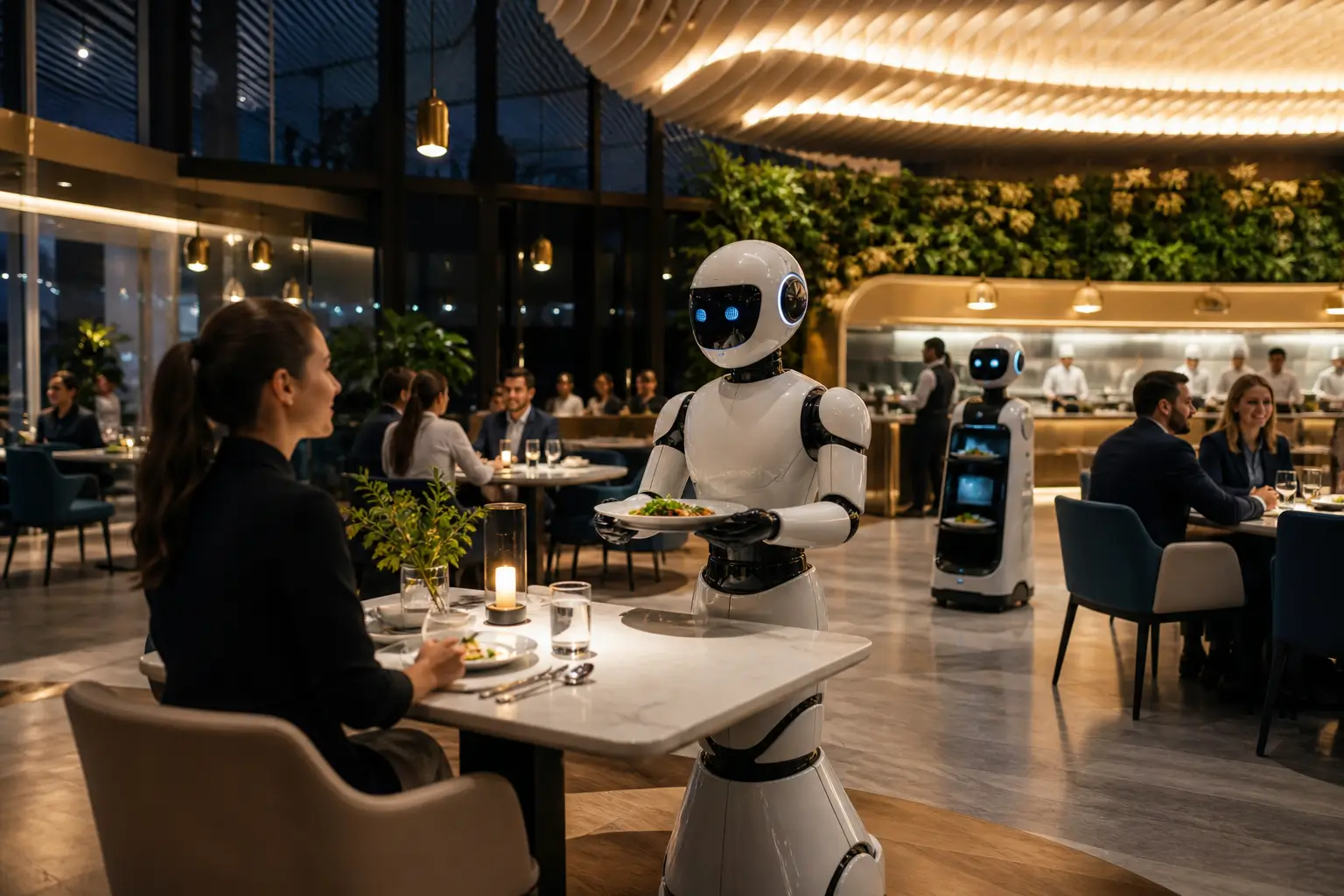
Walk into any five-star hotel lobby today, and something feels different. The sommelier recommends your wine before you even sit down. Your dietary preferences are already loaded into the kitchen system. The bar is mixing cocktails with robotic precision. And somewhere deep inside the hotel’s infrastructure, an AI engine is deciding how many kilos of salmon to order for tomorrow’s breakfast buffet.
This is not the future. This is happening right now.
The food and beverage (F&B) industry inside hotels — what the French call restauration hôtelière — is going through its most dramatic transformation since Auguste Escoffier reorganized the professional kitchen in the late 1800s. Technology and artificial intelligence are no longer optional upgrades. They are becoming the backbone of how hotel restaurants, bars, room service operations, and banquet kitchens actually function.
I have spent time studying what is happening across hotel chains globally — from boutique properties in Paris to mega-resort complexes in Dubai — and the picture is both exciting and, frankly, a little mind-bending. In this article, I am going to break down the specific technologies reshaping hotel F&B, explain what they actually do, back it up with real numbers, and show you why this shift matters for guests, chefs, and hotel owners alike.
The Scale of the Shift: Why Hotel F&B Is a Technology Goldmine
Before diving into individual technologies, let me set the stage with some numbers that explain why so much investment is flooding into this space.
Hotel food and beverage operations generate, on average, between 20% and 35% of total hotel revenue. At luxury properties, that figure can climb even higher. According to research from Deloitte, global hotel F&B revenue was valued at over $200 billion annually pre-pandemic, and post-pandemic recovery has pushed those numbers further upward as dining-in-hotel has become more experiential than ever.
Yet the margins are brutal. Labor costs eat 35% to 40% of F&B revenue. Food waste in hotel kitchens averages 20% to 30% of all purchased inventory. And guest expectations have never been higher — 73% of hotel guests say the quality of on-property dining directly influences whether they return to a property, according to data from Cornell’s Center for Hospitality Research.
This is the perfect pressure cooker — pun intended — for technology adoption. The pain points are real, the budgets exist, and the competitive pressure is fierce. AI and new digital tools offer hotels a genuine path toward solving all three problems simultaneously: lower costs, less waste, and better guest experiences.
AI-Powered Menu Engineering: La Carte Intelligente
Menu engineering — what the French might call la carte intelligente — has existed as a concept since the 1980s, when Cornell professors Donald Smith and Michael Kasavana first classified menu items as Stars, Plowhorses, Puzzles, and Dogs based on profitability and popularity. But that framework required manual spreadsheet analysis, updated maybe quarterly.
AI changes everything about that cycle.
Modern AI platforms like Avero, Craftable, and Toast Intelligence pull real-time sales data, weather forecasts, local event calendars, seasonal ingredient pricing, and even social media sentiment to predict exactly which dishes will sell on any given night — and at what price point. A hotel restaurant in New York City can now analyze 18 months of transactional data, cross-reference it with a major convention scheduled at the Javits Center three weeks out, factor in a cold snap in the forecast, and automatically recommend that the chef feature a hearty slow-braised short rib rather than the lighter grilled sea bass.
The financial impact is not trivial. Hotels using AI-powered menu optimization report average profitability increases of 10% to 15% on food margins. That sounds modest until you realize a 400-room full-service hotel might be running $6 million annually through its restaurant — meaning a 12% improvement is $720,000 in recovered profit per year.
Beyond profitability, AI menu tools are also helping hotels personalize at scale. Guest data from loyalty programs feeds back into menu recommendations — so a returning guest who always orders vegetarian gets a tailored menu highlight on their room’s digital concierge app showing tonight’s plant-based chef specials. Personalization at this level was impossible without machine learning sorting through thousands of data points per guest.
Smart Inventory Management and Predictive Ordering: Ending the Waste Problem
Food waste in hotel kitchens is one of the industry’s most embarrassing and costly open secrets. The average hotel wastes between 28% and 35% of its purchased food inventory — a staggering inefficiency that hits both the bottom line and the environment hard. In a 500-room full-service hotel running a full buffet breakfast, an all-day dining restaurant, room service, and banquet operations, that waste can translate to hundreds of thousands of dollars per year simply thrown in the bin.
AI-powered inventory management systems are attacking this problem with a level of precision that was simply not possible before. Platforms like Winnow, Leanpath, and Oracle MICROS Materials Control use a combination of machine learning, smart scales, and computer vision cameras placed at kitchen waste stations. Every time a kitchen worker discards food — whether it’s overproduced breakfast eggs or wilted lettuce that was never used — the system photographs it, weighs it, categorizes it, and logs the cost automatically.
Over weeks and months, the AI builds a pattern-recognition model specific to that property. It learns that the hotel over-orders cherry tomatoes every Tuesday because of an optimistic salad bar projection that rarely materializes. It identifies that the Sunday brunch always runs out of smoked salmon forty minutes early — causing guest complaints and last-minute scrambles to the supplier. It flags that a specific sous chef’s station consistently over-portions salmon fillets by fifteen grams per plate, adding up to significant cost over a high-volume service.
The results speak for themselves. Marriott International piloted Winnow’s AI waste system across multiple properties and reported waste reductions of 40% to 60% within the first year. The Mandarin Oriental hotel group has committed to eliminating food waste to landfill across its portfolio in part through AI-assisted kitchen management. Smaller boutique properties using Leanpath report payback periods of under six months on the technology investment.
Predictive ordering — la commande prédictive — takes this a step further. Rather than relying on a chef or purchasing manager’s intuition, AI systems now integrate with PMS (Property Management System) data to know how many guests are arriving, cross-reference historical F&B consumption patterns for similar occupancy levels, factor in banquet events already on the books, and auto-generate purchase orders to suppliers. The system literally tells the hotel what to buy, in what quantity, and when to order it to minimize both waste and stock-out situations.
Robotics and Automation in Hotel Kitchens: La Cuisine Automatisée
The robotic kitchen — la cuisine automatisée — sounds like science fiction. But across the hotel industry, it is becoming a practical reality, particularly in high-volume or standardized food production environments.
Let me be honest here: robots are not replacing the executive chef crafting a tasting menu at a Michelin-starred hotel restaurant. That is not happening any time soon. What robots are doing is taking over the repetitive, time-consuming, physically demanding tasks that kitchen workers perform thousands of times per shift — chopping vegetables, flipping burgers, frying items to precise temperatures, making consistent coffee drinks, plating standardized items, and running food from kitchen to table.
Maidbot, Keenon Robotics, and Bear Robotics have deployed food-delivery robots in hotel dining rooms across Asia, the Middle East, and increasingly North America. These robots navigate between tables using LiDAR sensors and AI pathfinding, carry dishes directly from the kitchen pass to the table, and free up human servers to focus on guest interaction, upselling, and the emotional intelligence aspects of hospitality that machines genuinely cannot replicate.
In the breakfast buffet environment — a notoriously labor-intensive operation in full-service hotels — robotic systems are now being deployed for egg-cooking stations, waffle makers, and juice-dispensing setups. The Henn-na Hotel in Japan famously uses robot staff for multiple guest-facing roles, and their F&B operation has incorporated automated stations that reduce morning staffing requirements significantly.
The cost math is compelling. A kitchen robot handling deep-frying or burger-flipping costs roughly $3,000 to $10,000 per year to operate including maintenance, compared to a human worker at $30,000 to $45,000 annually in a mid-cost city. For high-volume properties running 600-cover-a-day restaurants, the economics shift dramatically in favor of selective automation of specific tasks.
That said, the best hotel operators are not deploying robots to eliminate human jobs wholesale. They are redeploying human talent toward higher-value interactions — tableside service, sommelier consultations, personalized guest experiences — while letting machines handle the mechanical and repetitive work. This is the intelligent hybrid kitchen model that leading hotel groups are quietly building.
AI-Driven Guest Personalization: Knowing What You Want Before You Ask
The French concept of le service personnalisé — truly personalized service — has long been the holy grail of luxury hospitality. The legendary maître d’ who remembered every regular guest’s preferences, their dietary restrictions, their favorite table, the wine they ordered on their anniversary three years ago. That level of personal attention was once the exclusive province of the most elite properties, dependent entirely on the institutional memory of long-tenured staff.
AI is now democratizing this capability.
Modern hotel CRM and F&B platforms like Salesforce Hospitality Cloud, Amadeus Service Optimization, and SevenRooms integrate loyalty program data, past dining history, room service orders, special occasion notes, allergy profiles, and even social media data into a single guest intelligence profile. When a guest checks in — whether it is their first visit in three years or their twentieth stay — the F&B team sees a complete picture of who this person is as a diner.
The practical applications across a hotel F&B operation look like this:
- Allergy and dietary preference management — Guest profiles automatically flag allergies and dietary requirements (gluten-free, halal, vegan, nut allergy) to every F&B outlet across the property, reducing the risk of incidents and eliminating the awkward conversation every single time. A guest who flagged a shellfish allergy at check-in three years ago will find that their room service menu has automatically filtered or flagged shellfish items on every subsequent stay.
- Personalized room service recommendations — AI models analyze a guest’s past room service ordering patterns and time-of-day behavior to surface contextually relevant suggestions. A guest who always orders a club sandwich and sparkling water at 11pm gets that exact suggestion at the top of the digital room service menu, not buried somewhere on page four.
- Occasion recognition — Loyalty data showing a guest’s anniversary date or birthday triggers automatic F&B team notifications. The restaurant can proactively reach out, offer a special table, or have a small amenity waiting without the guest having to ask.
- Dynamic dietary menus — AI systems can generate a custom version of the restaurant menu for individual guests, highlighting dishes that match their dietary profile, hiding items that conflict with their allergies, and showcasing new items the algorithm predicts they would enjoy based on previous order history.
- Post-stay feedback loop — Machine learning models analyze post-stay survey responses and online reviews specifically related to F&B experiences, identifying patterns that inform menu changes, service improvements, and operational adjustments.
The commercial upside is significant. Hotels using advanced guest personalization in F&B report increases in per-guest F&B spend of 12% to 18%, simply because personalized recommendations drive higher confidence in trying new items and reduce decision friction.
Smart Bar Technology and Beverage Innovation: Le Bar Intelligent
The hotel bar — le bar intelligent — is undergoing its own parallel revolution. Beverage operations represent some of the highest-margin business in the entire hotel P&L, yet they have historically been the least technology-integrated part of the F&B operation.
That gap is closing fast.
AI-driven beverage management systems now handle inventory tracking, pour cost analysis, waste detection, and staff performance monitoring with a precision that manual bar management simply cannot match. Systems like BevInco, Sculpture Hospitality, and BarTrack use flow meters attached directly to draft beer and spirits lines to measure every single pour in real-time. The system knows the exact volume that left the bottle. It knows what was rung into the POS. And the difference — what the industry calls shrinkage — is tracked to the milliliter.
This matters enormously because beverage shrinkage (through over-pouring, spillage, theft, or complimentary drinks not properly documented) typically runs between 15% and 25% in hotel bars that lack proper controls. A hotel bar doing $1.5 million in annual beverage revenue with 20% shrinkage is losing $300,000 per year. Smart pour systems routinely cut shrinkage to under 5%.
Beyond cost control, AI is transforming the creative side of hotel bars. Platforms like Mackmyra (the AI-assisted whisky blending tool) and beverage AI consultancies are helping hotel bars develop signature cocktail menus using flavor-pairing algorithms and trend prediction models. These tools analyze thousands of cocktail recipes, map flavor compounds, identify emerging ingredient trends from global social media and spirits industry data, and suggest novel combinations that a human bartender might never think to try.
Robotic cocktail makers — most famously Tipsy Robot in Las Vegas and Makr Shakr in cruise ships and hotels — are making their way into hotel lobby bars, particularly in high-volume convention hotels where speed and consistency during peak periods is critical. A robotic cocktail system can make 120 cocktails per hour with perfect consistency, at a cost far below staffing a traditional bar team during peak convention traffic.
Digital Dining and Contactless Technology: The Post-Pandemic Permanent Shift
If the pandemic did one positive thing for hotel F&B technology adoption, it was this: it forced the industry to implement digital and contactless tools in about eighteen months that might otherwise have taken a decade to roll out.
QR code menus — initially a temporary safety measure — revealed something unexpected. Guest satisfaction with digital menus was measurably higher than with physical menus in multiple hotel operator surveys, because digital menus could be instantly updated, include photos and descriptions, show allergen information transparently, display real-time availability, and be available in multiple languages with one tap.
Mobile ordering for room service, pool bar, and beach service has accelerated dramatically. Platforms like ALICE Technologies, Quore, and Intelity allow hotel guests to order food and beverages directly from their smartphone — without calling the front desk, without flagging down a server, without waiting on hold. Orders route directly to the kitchen or bar POS system. The guest gets a real-time status update on their order.
The operational impact on hotels has been striking. Average room service order time dropped by 22% when mobile ordering replaced phone ordering, according to operator data from Intelity’s platform. Average order value increased by 14% — largely because digital menus with photos and descriptions encourage guests to add items they would not have thought to request verbally over the phone.
AI-powered chatbots now handle initial F&B inquiries across many hotel properties. A guest messaging the hotel at midnight about whether room service is available, what the allergy-friendly options are, or how long a delivery will take gets an instant, accurate AI response rather than waiting for a human operator to pick up.
Sustainability Technology in Hotel F&B: La Durabilité Numérique
Sustainability — la durabilité — is no longer a marketing buzzword in hotel F&B. It is a genuine operational priority driven by guest expectations, investor pressure, regulatory requirements, and frankly, the basic economics of waste reduction.
Technology is the engine making sustainability ambitions operationally achievable. Beyond the AI waste management systems I discussed earlier, several other technology categories are reshaping how hotels approach sustainable F&B operations.
Carbon footprint tracking software now integrates directly with procurement systems, assigning a carbon score to every ingredient purchased. A hotel chef making a menu decision can see not just the cost per portion of grass-fed beef versus plant-based protein, but the carbon impact of that choice per plate. Platforms like Foodsteps and HowGood provide this real-time carbon intelligence at the ingredient level.
Vertical farming partnerships are growing among hotel groups. Companies like Plenty, AeroFarms, and local urban farming startups are providing hotels with hyper-local, year-round produce grown in controlled indoor environments with 95% less water than conventional agriculture and zero pesticides. The Four Seasons in various cities has partnered with local vertical farms to source herbs and microgreens directly. The Rosewood Hotel Group has been investing in on-property gardens and local vertical farm partnerships as a core F&B identity element.
Dynamic sourcing platforms use AI to connect hotel purchasing teams with local and regional suppliers in real-time, optimizing for both price and sustainability metrics simultaneously. Rather than defaulting to a national distributor for everything, these platforms identify when a local producer has seasonal surplus at a competitive price, reducing food miles and supporting regional agriculture.
Water technology is another frontier. Smart dishwashing systems in hotel kitchens now use AI to optimize water and detergent usage per cycle based on actual soil load detected by sensors, cutting water consumption by 30% to 40% compared to fixed-cycle systems.
The Technology Stack: What a Modern Hotel F&B Operation Actually Looks Like
Let me paint a concrete picture of what a technology-forward hotel F&B operation is actually running today. This is not speculation — these are real platform categories being deployed across major hotel groups right now.
- Property Management System (PMS) — The operational backbone (Opera Cloud, Maestro, Mews). Everything else integrates into or pulls data from this system.
- Point of Sale (POS) System — The transaction and order management core (Toast, Simphony by Oracle, Lightspeed). AI-enabled POS systems now do real-time upsell prompting and menu performance analytics.
- Inventory and Procurement Management — Automated ordering and waste tracking (Birchstreet, Oracle Materials Management, Apicbase). These platforms connect purchasing to actual consumption data automatically.
- Waste Intelligence Platform — Computer vision and smart scale systems (Winnow, Leanpath) tracking what is discarded and why at the kitchen level.
- Guest CRM and Personalization Engine — Guest intelligence and personalization management (SevenRooms, Salesforce Hospitality, Revinate). This feeds personalized F&B recommendations back to every guest touchpoint.
- Revenue Management Integration — F&B revenue optimization aligned with room occupancy forecasting (IDeaS, Duetto). These systems ensure F&B staffing and production align with predicted hotel occupancy curves.
- Digital Menu and Ordering Platform — Mobile-first ordering, QR menus, and digital concierge (Intelity, ALICE, Agilysys). The guest-facing interface for digital F&B interaction.
- Bar Management and Beverage Control — Pour tracking, inventory, and cost control for beverage operations (BarTrack, BevInco, Sculpture Hospitality).
- Sustainability and Carbon Tracking — Ingredient-level sustainability scoring integrated into procurement (Foodsteps, HowGood, Spoiler Alert for surplus management).
- Kitchen Display Systems (KDS) with AI Optimization — Smart kitchen order sequencing and timing systems (Olo, HungerRush, Square for Restaurants). AI-powered KDS now sequences orders dynamically to optimize kitchen throughput and minimize wait times even during peak periods, routing tickets to the most appropriate station based on current workload distribution.
- Staff Scheduling with AI Forecasting — Labor management platforms (HotSchedules by Fourth, Harri) that use AI to build staffing schedules aligned with predicted covers, events, and historical demand patterns, reducing both under-staffing crises and costly over-staffing.
- Guest Feedback and Review Intelligence — AI-powered reputation management tools (TrustYou, ReviewPro) that analyze guest comments specifically about F&B experiences and surface actionable insights for the F&B leadership team in near real-time.
Each of these platforms does something meaningful independently. But the real power emerges when they integrate and share data — when the PMS occupancy forecast triggers the inventory system to auto-adjust purchase orders, which feeds into the kitchen display system’s production planning, which is tracked against actual waste by the waste intelligence platform, and reconciled against POS transaction data to produce a real-time picture of F&B performance that the chef and F&B director can act on today rather than waiting for a monthly report.
Challenges and What Hotels Are Getting Wrong
I want to be honest here, because the technology vendor sales pitches are relentlessly optimistic, and the reality on the ground is more complicated.
Integration is the single biggest challenge in hotel F&B technology. Most mid-scale and independent hotels are running a patchwork of legacy systems that do not talk to each other cleanly. The PMS is from one vendor. The POS is from another. The inventory system was installed eight years ago and has limited API capability. Building the integrated data environment that actually unlocks AI’s potential is expensive, time-consuming, and organizationally disruptive.
Change management is the second major hurdle. Executive chefs who have spent twenty years running kitchens by instinct and experience do not always welcome an AI system suggesting they are over-ordering or mis-portioning. The cultural shift required to make data-driven F&B operations work requires genuine buy-in from culinary and F&B leadership — not just a mandate from the CFO to implement new software.
Data quality is the third challenge. AI systems are only as good as the data they learn from. Hotels with inconsistent POS item coding, irregular inventory processes, or poor historical data records will find AI recommendations unreliable in the early stages of implementation.
And finally, the guest experience balance. Technology should never make a hotel’s F&B operation feel clinical, transactional, or impersonal. The warmth of hospitality — what the French call l’art de recevoir, the art of receiving — is the fundamental product that hotel restaurants are actually selling. Technology that streamlines costs but erodes that warmth is a bad trade.
Conclusion: The Hotels That Embrace This Now Will Win
I am not going to pretend this transformation is simple or cheap. Implementing a genuinely intelligent, integrated F&B technology stack across a full-service hotel property is a multi-year, multi-million-dollar undertaking at scale. Even for smaller boutique properties, the change management and learning curve involved is real.
But I am convinced — after looking at the data and the early results from leading hotel operators — that the window for competitive advantage through F&B technology is still open. The hotels that are implementing these tools thoughtfully right now are building operational capabilities that will be very difficult for slower-moving competitors to replicate quickly.
The fundamental equation is this: AI and new technology in hotel F&B do not replace the creativity of a talented chef, the warmth of an excellent host, or the irreplaceable human magic of a truly memorable dining experience. What they do is remove the friction, waste, inconsistency, and cost inefficiency that currently drain value from hotel F&B operations — freeing up both money and human energy to invest in the experiential quality that guests actually remember.
The kitchen of the future is not a cold, robotic factory. It is a place where talented culinary professionals are supported by intelligent tools that handle the mechanical and analytical work — so that human skill, creativity, and hospitality can do what they have always done best. Feed people beautifully.
Frequently Asked Questions (FAQs)
1. How is artificial intelligence used in hotel food and beverage operations?
Artificial intelligence in hotel food and beverage operations is applied across multiple functions including menu engineering and profitability analysis, predictive inventory management and automated purchasing, guest personalization using historical dining preference data, waste reduction through computer vision and machine learning at kitchen waste stations, revenue management optimization aligned with hotel occupancy forecasting, and dynamic staff scheduling based on predicted demand. AI systems do not operate as standalone tools — their greatest value comes when they integrate across the full hotel technology stack, creating a data-driven feedback loop across every aspect of F&B operations from procurement through service delivery to post-stay guest feedback analysis.
2. What technology is used in hotel kitchen management today?
Modern hotel kitchen management technology includes AI-powered inventory management platforms like Apicbase and Birchstreet that automate purchasing aligned with demand forecasts, waste intelligence systems like Winnow and Leanpath that use computer vision to track and analyze kitchen waste at the point of discard, smart kitchen display systems (KDS) that sequence orders dynamically based on kitchen workload, temperature monitoring sensors integrated with HACCP compliance systems, robotic cooking and food-delivery systems for high-volume standardized production, and cloud-based recipe management platforms that standardize portion sizing and costing across multiple outlets within a hotel property.
3. How does AI reduce food waste in hotel restaurants?
AI reduces food waste in hotel restaurants primarily through two mechanisms. First, predictive ordering systems use occupancy data, historical consumption patterns, event booking data, and seasonal demand forecasting to generate purchase orders calibrated to actual expected demand — reducing over-purchasing at the source. Second, real-time waste tracking systems using smart scales and computer vision cameras placed at kitchen discard stations identify exactly what is being wasted, when, and in what quantities. Machine learning algorithms analyze these waste patterns over time, identifying root causes — whether it is over-production, poor portioning, spec non-compliance, or suboptimal inventory rotation — and surface specific, actionable recommendations to kitchen management for reducing waste at each identified source.
4. What is the future of hotel restaurant technology and guest personalization?
The future of hotel restaurant technology is moving toward seamless, invisible personalization where every aspect of a guest’s F&B experience is shaped by intelligent systems working in the background. This includes hyper-personalized digital menus that adapt in real-time based on guest dietary profiles, allergy data, and preference history; voice-activated room service ordering through smart speakers in hotel rooms; AI sommelier tools that recommend wine pairings based on the specific dishes a guest has ordered combined with their previous wine selections; biometric and wearable integration that could eventually allow dietary and wellness data from a guest’s health devices to inform F&B recommendations; and fully integrated loyalty systems where F&B purchases across an entire hotel group accumulate into a single preference intelligence profile that follows the guest from property to property globally.
5. How are hotels using robots in food and beverage service?
Hotels are deploying robots in food and beverage service in several distinct applications. Food delivery robots — built by companies like Keenon Robotics and Bear Robotics — navigate hotel restaurant floors and hallways autonomously using LiDAR sensor arrays and AI pathfinding, carrying dishes from kitchen to table or delivering room service orders to guest room doors. Robotic cocktail systems like Makr Shakr produce cocktails with mechanical precision and consistent pour measurements, particularly useful in high-volume lobby bars during peak convention periods. Automated breakfast stations handle repetitive cooking tasks including egg preparation, waffle cooking, and juice dispensing in large hotel breakfast buffet operations. Kitchen robots handle standardized food preparation tasks — chopping, frying, and plating — freeing human culinary staff to focus on creative, complex, and guest-facing aspects of food preparation. It is important to note that the hotel industry is deploying robots selectively to complement rather than wholesale replace human hospitality workers, concentrating automation on tasks where consistency, speed, and cost efficiency matter most.