
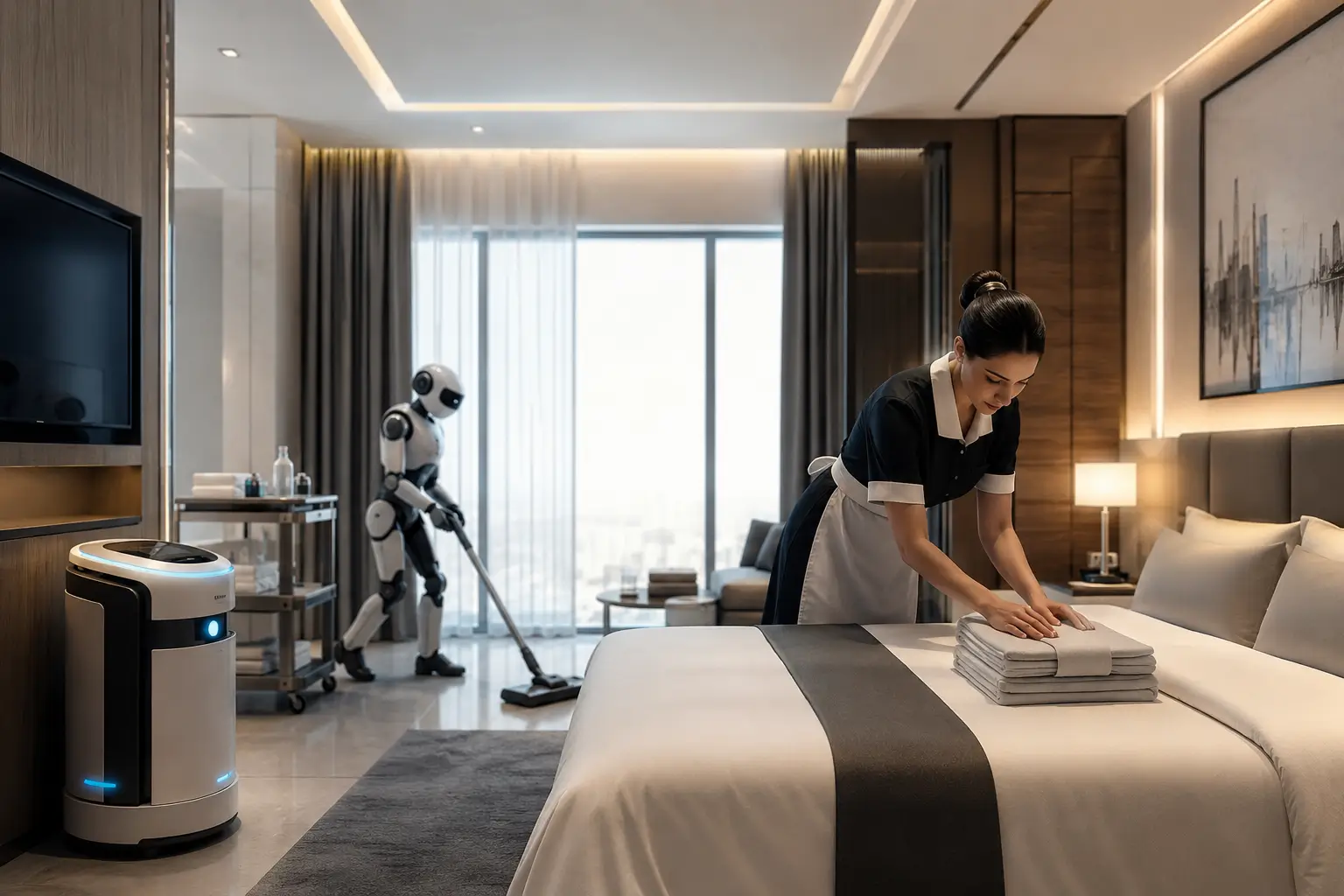
Walk into a five-star hotel room. The sheets are crisp. The bathroom smells like eucalyptus. The minibar is stocked exactly right. You probably think about the view, the pillow menu, the Nespresso machine on the counter. You rarely think about the army of people — and increasingly, machines — who made all of that happen before you arrived.
Hotel housekeeping, or le service d’étage as the French hospitality industry calls it, has always been the backbone of the guest experience. It is labor-intensive. It is time-sensitive. And for decades, it ran almost entirely on clipboards, walkie-talkies, and institutional memory. That era is ending fast.
I have spent time researching how hotels across Asia, Europe, and North America are adopting artificial intelligence, robotics, IoT sensors, and predictive analytics into their housekeeping operations. What I found is not a story about robots replacing humans. It is a story about smarter workflows, happier staff, lower costs, and guests who keep coming back.
In this article, I break down every major technology reshaping hotel housekeeping today — what it is, where it came from, and why it matters to hotel operators right now.
What Is Smart Housekeeping? Redefining La Gestion du Ménage
Smart housekeeping refers to the use of digital technology, automation, and data intelligence to manage, optimize, and execute room cleaning operations inside a hotel. The term itself is relatively new — it started gaining traction around 2018 when property management systems began integrating with IoT devices at scale.
The traditional model was reactive. A guest checks out. The front desk notifies housekeeping. A housekeeper walks to the room, cleans it, and marks it done on a paper sheet or a basic app. The whole process relied on manual communication, and errors were common. Rooms got missed. Priorities got scrambled. Supervisors had no real-time visibility into what was happening on each floor.
Smart housekeeping flips this model. It is proactive, data-driven, and connected. Sensors in rooms track occupancy. Algorithms assign rooms to staff based on location, workload, and skill level. Managers watch live dashboards from their phones. Predictive systems flag which rooms will need deep cleaning based on guest history and length of stay. According to a 2023 report by Hospitality Technology Magazine, hotels using smart housekeeping platforms reduced room turnaround time by an average of 23%. That is not a minor improvement — in a 300-room hotel running at 85% occupancy, that translates to significant revenue protection during peak check-in windows.
AI-Powered Task Management: The Brain Behind the Operation
Artificial intelligence in housekeeping is not science fiction. It is already running in hundreds of hotels globally. The core application is task management — using machine learning algorithms to automatically assign, sequence, and reprioritize cleaning tasks based on real-time data.
Systems like ALICE Technologies, Quore, and Optii Solutions pull data from the property management system (PMS), reservation data, and even restaurant bookings to predict when guests will leave their rooms. The AI then creates optimized cleaning routes for each housekeeper, reducing unnecessary walking between floors and cutting the dead time between task completion and the next assignment.
Here is why this matters operationally. A housekeeper in a typical 400-room hotel walks an average of 8 to 10 kilometers per shift. Much of that walking is inefficient — going back to the linen cart, revisiting rooms that were occupied when first approached, waiting for a supervisor to assign the next task. AI routing can cut this wasted movement by up to 30%, according to data published by Optii Solutions in 2022.
Beyond routing, AI systems learn over time. They track which rooms take longer to clean, which guests consistently leave rooms in worse condition, and which housekeepers work most efficiently at different times of day. This is l’intelligence opérationnelle — operational intelligence — applied at the room level. The result is a housekeeping operation that improves itself week over week without anyone having to manually analyze spreadsheets.
IoT Sensors and Smart Room Technology: Listening to the Building
The Internet of Things, or l’Internet des Objets, has given hotels the ability to literally listen to their buildings. Sensors embedded in rooms, corridors, and HVAC systems generate continuous streams of data that housekeeping managers can act on immediately.
Here are the most impactful IoT applications I found in modern hotel housekeeping, each one changing operations in a specific and measurable way:
- Occupancy sensors — Passive infrared or microwave sensors detect whether a guest is physically in the room. When a room goes empty, the system instantly flags it for housekeeping without waiting for a do-not-disturb light to turn off or front desk communication. This alone can reduce room cleaning delays by 15 to 20 minutes per room.
- Smart door locks — Modern keycard and mobile key systems log every entry and exit with a timestamp. Housekeeping software uses this data to confirm a guest has actually left before dispatching a room attendant, eliminating the awkward and disruptive experience of knocking on an occupied room.
- Minibar sensors — Weight-sensitive minibar shelves detect when an item is removed and automatically update the guest’s billing system. Housekeeping no longer needs to manually check and report minibar consumption during each service.
- Linen tracking with RFID — Radio-frequency identification tags sewn into towels, sheets, and robes allow hotels to track exactly where every piece of linen is at any moment — in the room, in the laundry, in storage, or missing. The Marriott group piloted RFID linen tracking across several properties and reported linen loss reductions of up to 40%.
- Water leak sensors — Placed under sinks, behind toilets, and near bathtub drains, these sensors alert maintenance and housekeeping before a minor leak becomes a flooded bathroom or a ruined floor. Preventive response saves thousands in property damage per incident.
- Air quality monitors — Sensors tracking CO2 levels, humidity, and VOC (volatile organic compounds) help housekeeping determine whether a room needs extra ventilation or deep cleaning of soft furnishings before a new guest arrives.
- Smart thermostats — When a room sits empty for more than a set period, the thermostat adjusts automatically to save energy. When housekeeping enters, the system restores the preset temperature so the room is comfortable when cleaned.
- TV and device usage logs — Some hotels use smart TV data to detect extended guest absence from a room even if occupancy sensors are unavailable, flagging rooms for potential same-day service without violating privacy.
- Noise level monitors — Discreet acoustic sensors (not recording audio, just measuring decibel levels) can detect unusual noise patterns — parties, large gatherings — that would alert housekeeping to prepare for a more intensive post-checkout clean.
- Guest app integration — When guests use in-app features to request towels, report a maintenance issue, or delay housekeeping, that data feeds directly into the task management system, updating priorities in real time without a single phone call.
Housekeeping Robots: Les Robots de Nettoyage Enter the Floor
Autonomous cleaning robots are no longer a novelty. They are increasingly a line item in hotel capital budgets. But understanding what they actually do — and what they cannot do — is essential before writing them off as gimmicks or overhyping them as replacements for human staff.
The most commercially deployed robots in hotel housekeeping today fall into two categories: floor-cleaning robots and delivery robots.
Floor-cleaning robots like the Avidbots Neo and the Tennant T7 AMR navigate corridors and large common areas using LIDAR and camera-based mapping. They scrub, vacuum, or mop continuously during low-traffic hours — typically between midnight and 6 AM — covering ground that would otherwise require two or three human staff members working through the night. A single robot unit can clean 2,000 to 4,000 square meters per night. In large convention hotels, this is operationally significant.
Delivery robots — brands like Relay by Savioke and Aethon TUG — handle in-room delivery of towels, toiletries, and amenities. The guest requests an item via an app or in-room device. A robot loads up in a housekeeping closet, navigates the elevator, arrives at the door, and the guest retrieves the item from its cargo compartment. These robots do not replace room attendants. They free them from running individual delivery trips, which can consume 20 to 30 minutes per shift on busy nights.
The financial case is real. A robot unit costs between $30,000 and $80,000 depending on capability, with maintenance contracts running $5,000 to $15,000 annually. Against the cost of a full-time night shift worker — factoring in wages, benefits, turnover costs, and training — the payback period in high-labor-cost markets is typically two to four years.
Predictive Analytics in Housekeeping: Seeing Tomorrow’s Workload Today
Predictive analytics is where hotel housekeeping starts to feel genuinely futuristic. Using historical data, booking patterns, and even external variables like local events and weather, predictive systems give housekeeping managers a clear view of tomorrow’s workload today.
L’analyse prédictive works by pulling together data points that individually seem unrelated but collectively paint an accurate picture of operational demand. A data model might factor in the following: current occupancy rate, average length of stay by booking channel, number of guests per room, day of week, proximity to local events (conferences, sports games), and historical cleaning time for each room type.
From this, the system produces a staffing forecast. It tells the housekeeping manager how many room attendants will be needed on Tuesday versus Wednesday, which floors will have the highest turnover, and whether a deep-clean team should be scheduled for the weekend’s departures. This replaces gut-feel scheduling with evidence-based planning.
According to McKinsey’s 2023 report on hospitality operations, hotels using predictive workforce management tools reduced overtime costs by an average of 18% and decreased day-of scheduling changes by 31%. Both figures represent direct cost savings and significant reductions in staff stress — because last-minute schedule changes are one of the top drivers of housekeeping staff turnover, which in the US hospitality industry runs at a brutal 70 to 80% annually.
Green Housekeeping Technology: Sustainability Meets La Durabilité
Sustainability is not a side topic in modern hotel housekeeping. It is a central operational and commercial priority. Guests increasingly choose hotels based on environmental credentials, and regulators in many markets are tightening requirements around water use, chemical discharge, and energy consumption.
Technology is making sustainable housekeeping both easier and more measurable. Electrolyzed water systems, for example, use electricity to convert ordinary tap water and a small amount of salt into a powerful, non-toxic cleaning solution. Hotels like the Westin and Four Seasons properties in California have deployed these systems, eliminating dozens of chemical cleaning products from their housekeeping carts without compromising cleaning standards.
Laundry technology has also advanced dramatically. Ozone laundry systems inject ozone gas into cold wash cycles, achieving the same sanitization results as hot water washes but using up to 30% less energy and extending linen lifespan by reducing thermal degradation. For a 500-room hotel washing several hundred kilograms of linen daily, this is a significant cost and sustainability win.
Smart dispensing systems for cleaning chemicals use RFID or barcode scanning to release exactly the right amount of product for each task, eliminating the over-dosing that is endemic in manual dispensing and reducing chemical consumption by 20 to 40% across a property.
Water recycling systems in laundry operations capture and filter greywater from rinse cycles for reuse in the next wash, cutting total water consumption in hotel laundries by up to 40%. Given that a large hotel laundry can use 300,000 to 500,000 liters of water per month, this represents enormous savings in both cost and environmental impact.
Staff Training Technology: Digital Learning on the Floor
One of the most overlooked areas of housekeeping technology is staff training. Turnover in hotel housekeeping is high — new staff need to learn complex, property-specific procedures quickly, and traditional training methods (shadowing, printed manuals, classroom sessions) are slow and inconsistent.
Digital training platforms now deliver step-by-step cleaning instructions through tablets or smartphones, with visual guides, video walkthroughs, and language localization for multilingual teams. Platforms like Typsy, Knowcross, and HotSOS allow properties to standardize procedures across multiple floors and shifts, ensuring that a checkout clean on the 12th floor meets exactly the same standard as one on the 3rd floor.
Augmented reality is beginning to enter this space too. Some luxury properties are piloting AR headsets that overlay cleaning checklists, product instructions, and quality benchmarks directly in the housekeeper’s field of view as they work through a room. It is early-stage technology, but the potential for reducing training time and improving consistency is substantial.
Quality inspection apps allow supervisors to conduct room inspections using a tablet, photographing any deficiencies and logging them against a digital checklist. This data accumulates over time, identifying recurring issues, tracking individual performance trends, and feeding back into training programs. The result is a continuous improvement loop that traditional pen-and-paper inspections could never produce.
Challenges and Honest Realities of Technology Adoption
No technology rollout is without friction. I want to be direct about the challenges hotels face when adopting these systems, because the marketing materials rarely mention them.
Integration complexity is real. Most hotels run legacy property management systems that were not designed to communicate with modern IoT platforms or AI scheduling tools. Building API connections, migrating data, and training staff to trust a new system takes time — typically six to eighteen months for a full implementation at a mid-size property.
Staff resistance is also a factor. Housekeeping teams that have worked the same way for years sometimes view new technology as surveillance or a precursor to job cuts. Hotels that have succeeded in technology adoption have done so by involving staff in the process early, framing tools as assistants rather than monitors, and demonstrating tangible personal benefits like reduced workload and fewer last-minute schedule changes.
Cost remains a barrier for independent and budget-tier properties. Enterprise housekeeping management platforms can cost $15,000 to $50,000 per year in licensing fees, before hardware and implementation costs. For smaller properties, the ROI calculus is less clear, and the industry has not yet produced robust solutions scaled for the 80-room boutique hotel market.
Data privacy is a growing concern as room sensors become more sophisticated. Hotels must navigate guest expectations around privacy carefully, ensuring that occupancy detection and usage monitoring serve operational efficiency without crossing into surveillance. Clear, transparent communication with guests about what data is collected and how it is used is not optional — it is essential.
Conclusion: The Future of Le Service d’Étage Is Already Here
Hotel housekeeping is not glamorous. It never has been. But it is fundamental. A guest who finds a hair on the bathroom floor or waits 90 minutes for a towel does not forget. They write a review. They do not return.
What technology is doing for housekeeping is not replacing the human judgment and care that separate a good hotel room from a great one. It is removing the friction, the inefficiency, and the guesswork that have always made this department harder to manage than it should be.
The hotels winning on housekeeping right now are the ones treating it as a data and operations challenge, not just a labor management problem. They are investing in AI scheduling, IoT connectivity, predictive analytics, and sustainable cleaning technology — not because it is trendy, but because the operational and financial returns are tangible and measurable.
The technology is here. The question is simply how fast individual properties are willing to move.
Frequently Asked Questions
1. What is AI-powered housekeeping and how does it work in hotels? AI-powered housekeeping uses machine learning algorithms connected to a hotel’s property management system to automatically assign, sequence, and reprioritize cleaning tasks in real time. The AI analyzes check-out times, guest data, room types, and staff availability to create optimized work schedules and cleaning routes, reducing turnaround time and improving room readiness without manual intervention from supervisors.
2. How are robots used in hotel housekeeping? Hotels currently deploy two main types of robots in housekeeping: autonomous floor-cleaning robots that scrub or vacuum corridors and large common areas during off-peak hours, and delivery robots that transport towels, toiletries, and amenities directly to guest rooms on request. These robots handle repetitive, time-consuming tasks and free human staff to focus on room cleaning and guest interaction.
3. What IoT technology is used in hotel housekeeping? Hotels use a range of IoT devices to improve housekeeping efficiency, including occupancy sensors, smart door locks, RFID linen tracking tags, minibar weight sensors, water leak detectors, air quality monitors, smart thermostats, and noise level sensors. These devices feed live data into housekeeping management platforms, allowing managers to make faster and more accurate decisions about room prioritization and staff deployment.
4. How does technology help hotels with sustainable housekeeping? Technology supports sustainable housekeeping through electrolyzed water cleaning systems that eliminate chemical cleaning products, ozone laundry systems that reduce energy consumption by washing in cold water, smart chemical dispensers that prevent over-dosing, and water recycling systems in hotel laundries. Together, these tools significantly reduce a property’s chemical usage, energy consumption, and water footprint.
5. Is hotel housekeeping technology only for large luxury hotels? While large hotel chains and luxury properties have led adoption, housekeeping technology is increasingly available to mid-scale and even independent hotels. Cloud-based housekeeping management software, mobile inspection apps, and modular IoT solutions have reduced the cost barrier significantly. Smaller properties can start with basic task management apps and scale up as they see operational returns, rather than committing to enterprise-level platforms from the beginning.