
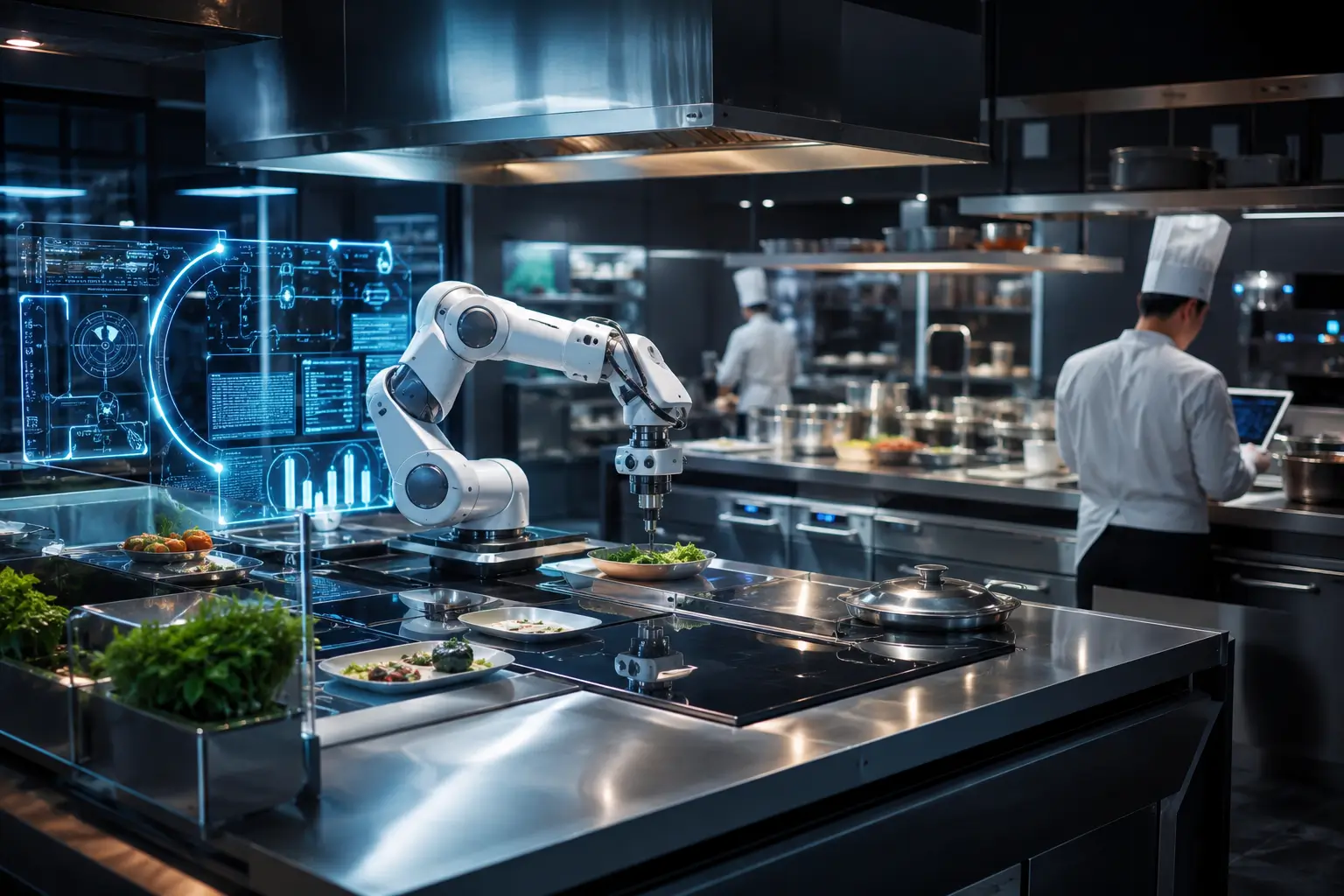
Walk into any five-star hotel at 6 AM, and the kitchen already smells of purpose. Stock is simmering. Pastry chefs are shaping croissants by hand. The brigade system — that French military-style hierarchy invented by Auguste Escoffier in the late 1800s — is already in full swing. The chef de cuisine calls the shots. The sous chef keeps the pace. The commis does the groundwork.
But something else is happening now. Something quieter, tucked behind the stainless steel surfaces and the walk-in refrigerators.
Technology is rewriting the kitchen.
Not in a dramatic, robot-arms-flipping-burgers kind of way — at least, not entirely. I am talking about a slow, precise infiltration of artificial intelligence, smart sensors, automated ordering systems, and data-driven cooking tools that are fundamentally changing how hotel kitchens think, plan, prep, and serve. The global hospitality tech market was valued at $5.8 billion in 2023, and projections put it well past $13 billion by 2030. A huge chunk of that growth is happening inside the kitchen.
This article breaks down each technology in depth — where it came from, what it does, and why hotel operators who ignore it are already falling behind.
La Cuisine Intelligente: What “Smart Kitchen” Actually Means
The term “smart kitchen” gets thrown around loosely. I want to anchor it properly. A smart kitchen, in the context of hotel hospitality, refers to a food production environment where data collection, machine learning, automation, and connected devices work together to improve efficiency, reduce waste, ensure food safety, and optimize the guest experience.
The concept traces back to the broader Internet of Things (IoT) movement that picked up real momentum around 2013, when Cisco estimated there were more connected devices on the planet than people. Kitchens were initially slow to adopt because food preparation, unlike manufacturing, involves enormous sensory complexity — smell, texture, temperature variation, cultural nuance. You cannot simply automate a perfectly reduced sauce the way you automate a car part.
But the tools have caught up. Modern smart kitchen systems combine multiple layers: cloud-connected equipment, real-time temperature and humidity sensors, AI-powered menu planning software, predictive inventory management, and digital workflow platforms that keep every station on the same page. According to a 2023 Deloitte survey on hospitality operations, hotels that had adopted even basic smart kitchen infrastructure reported a 22% reduction in food waste and a 17% improvement in kitchen throughput within the first year.
The smart kitchen is not a single product you can buy. It is an ecosystem. And that distinction matters because hotel operators sometimes make the mistake of investing in one piece of technology without building the connective tissue around it — and then wonder why results are underwhelming.
Predictive Inventory Management and AI-Powered Food Ordering
One of the most quietly powerful shifts in hotel kitchen technology is happening at the inventory level. For decades, hotel purchasing managers relied on experience, gut instinct, and manual spreadsheets to decide how much food to order. The result was predictable: over-ordering led to spoilage, under-ordering led to 86’d menu items and unhappy guests.
AI-powered inventory management systems changed this equation decisively.
These platforms pull historical consumption data, cross-reference it with occupancy forecasts, local events calendars, seasonal patterns, and even weather predictions to generate highly accurate purchasing recommendations. Systems like Apicbase, BlueCart, and Winnow have demonstrated food cost reductions between 15% and 30% in hotel environments. That is not a marginal improvement — for a 500-room hotel running three restaurants, that can represent hundreds of thousands of dollars annually.
Here is what makes it genuinely intelligent rather than just a fancier spreadsheet: machine learning. The system does not just apply a formula. It learns. If your hotel always sees a spike in breakfast covers on the Sunday after a major local sports event, the system begins factoring that in automatically — without you telling it to. It identifies patterns that human purchasing managers simply do not have the bandwidth to track across hundreds of ingredients simultaneously.
The other dimension is supplier integration. Many modern systems connect directly to supplier portals, enabling automatic purchase orders the moment stock falls below a threshold. This removes human delay from the reordering process entirely, which is critical for perishables. The gestion des stocks — stock management, as French culinary professionals call it — becomes genuinely proactive rather than reactive. Hotels running these systems report fewer last-minute scrambles and a measurable drop in emergency supplier calls.
Robotics in Hotel Kitchens: Automation at the Garde Manger and Beyond
Let me be direct about something: full kitchen automation is not happening at the fine dining level. Not soon. The craft, intuition, and emotional intelligence that a great chef brings to the plate cannot be replicated by a machine — and no serious technologist I have spoken to claims otherwise.
But automation absolutely has a place in hotel kitchens. Specifically in high-volume, repetitive, precision-dependent tasks. The garde manger — the cold kitchen section handling salads, cold appetizers, and charcuterie prep — is one area where automated slicing, portioning, and plating assistants are already saving significant labor hours.
Some of the most impactful kitchen automation technologies being deployed across hotel properties globally include:
- Automated vegetable prep machines — Systems like Robot Coupe’s commercial AI-assisted cutters now perform consistent julienne, brunoise, and chiffonade cuts with machine precision. A prep cook running one of these machines can process four times the volume in the same time, with zero variation in cut size — which matters enormously for presentation consistency across a 300-cover banquet.
- Conveyor-assisted cooking systems — Used extensively in hotel banquet kitchens, these systems move product through precisely controlled heat zones, eliminating the human error factor in timing. A filet mignon cooked to 135°F in a conveyor system will hit that temperature every single time.
- Automated cold storage retrieval — Several large hotel chains have installed robotic retrieval systems in their walk-in coolers and dry storage areas. These systems, operated via tablet interface, locate and deliver ingredients to the appropriate station, reducing time spent searching for product by an estimated 40 minutes per shift per kitchen.
- Dishwashing automation — While not glamorous, automated warewashing systems with AI-based load optimization and chemical dosing have cut water usage by up to 35% in large hotel kitchens, a genuine sustainability win.
- Automated beverage dispensing — In hotel bars and room service operations, precision pour systems controlled by AI ensure cocktail consistency while tracking inventory in real time. Waste from over-pouring drops dramatically.
- Cooking robots for repetitive items — Companies like Miso Robotics have developed robotic arms specifically designed for tasks like flipping proteins or managing fryer loads. Several hotel chains in the US have piloted these in high-volume breakfast kitchens where eggs, pancakes, and hash browns are produced in enormous quantities.
- Pastry and bread portioning automation — Boulangerie operations inside large hotels benefit enormously from dough portioning machines that divide and round dough pieces to within a gram of target weight, ensuring perfectly consistent rolls and pastry products at scale.
- Labeling and allergen tracking automation — Automated label printers integrated with recipe management software produce ingredient and allergen labels the moment a dish is prepared, dramatically reducing manual labeling errors that can have serious guest safety consequences.
- Smart ovens with recipe recall — Combi ovens from manufacturers like Rational and Convotherm now run saved programs tied directly to the hotel’s recipe management system. A cook with minimal training can produce a dish to exact specification by selecting the correct program — reducing dependency on highly skilled labor for every task.
- Automated tray assembly systems — In large hotel room service and banquet operations, conveyor-based tray assembly lines guided by camera vision systems can assemble and verify tray components faster and more accurately than fully manual assembly, with the AI flagging missing items before the tray leaves the kitchen.
Each of these represents not a replacement of the chef’s craft, but a reallocation of human skill toward where it creates the most value — conception, tasting, guest interaction, and quality control.
AI-Driven Menu Engineering: The Data Behind What Guests Actually Order
L’ingénierie du menu — menu engineering — has been a formal discipline since the 1980s when Cornell University researchers Michael Kasavana and Donald Smith developed the framework for categorizing menu items as Stars, Plowhorses, Puzzles, and Dogs based on profitability and popularity.
What AI does is take that 1980s framework and put it on steroids.
Modern menu engineering platforms analyze point-of-sale data from the hotel’s restaurant in real time, correlating item popularity with time of day, day of week, season, dining party size, table location, server, weather, and even proximity to local events. The system identifies which dishes are genuinely driving margin and which are silently dragging the food cost percentage up — things that would take a human analyst weeks to calculate manually get surfaced in a morning report.
But the most sophisticated systems go further. They analyze modifier patterns — the add-ons, substitutions, and customizations guests request — and flag opportunities to formalize popular modifications as menu features rather than off-menu adjustments. One hotel group in Singapore used this insight to redesign their breakfast menu entirely around discovered modification patterns, increasing average cover spend by 11% within three months.
AI also enables dynamic menu personalization. When integrated with the hotel’s property management system (PMS), the restaurant’s menu management platform can surface personalized recommendations to guests based on past stays, dietary preferences recorded in their guest profile, and current occupancy patterns. A returning guest who always orders plant-based options sees a subtly different menu interface than a new guest with no profile data. This is not science fiction — several luxury hotel brands are deploying this right now.
Food Waste Reduction Technology: When AI Meets Sustainability
Hotel kitchens are among the most significant contributors to commercial food waste globally. The United Nations Environment Programme estimated in its 2021 Food Waste Index that the hospitality sector accounts for approximately 12% of total global food waste — a staggering figure given the scale of the problem.
Technology is attacking this from multiple angles simultaneously.
Computer vision waste-tracking systems — Leanpath and Winnow’s Vision platform are the two most prominent — place cameras and scales at the point of waste: the prep station, the plate scraping station, and the production waste bin. The AI identifies what is being thrown away, how much, and at what stage. This granular data is more valuable than most operators realize.
Knowing that your kitchen wastes 4 kg of trimmed carrot tops daily does not just suggest composting. It prompts the question: why are we not using these in stocks, garnishes, or staff meals? The AI does not answer that question — the chef does. But the data surfaces the conversation that otherwise never happens.
Some systems go further. Predictive production planning tools analyze cover counts, historical consumption, and current prep quantities to recommend exactly how much of each dish component to produce for a given service period — reducing the overproduction that leads to end-of-service waste. Hotels running these systems alongside their inventory platforms have reported food waste reductions of 40% or more over 18 months.
The financial case is straightforward. Industry estimates suggest that every $1 invested in food waste reduction technology generates $7 in savings across the value chain. For a hotel operation doing $3 million in annual food revenue, cutting waste by even 20% translates directly to the bottom line.
IoT-Connected Kitchen Equipment and Food Safety Monitoring
Food safety has always been a non-negotiable in hospitality. A single foodborne illness incident can destroy a hotel restaurant’s reputation for years. But traditional food safety monitoring relied heavily on manual temperature logging — clipboard-and-pen records that were completed inconsistently, sometimes retroactively filled in, and offered no real-time alerts.
The IoT revolution changed this completely.
Modern connected kitchen environments deploy wireless temperature sensors inside every refrigeration unit, hot holding cabinet, and cooking appliance. These sensors report to a central platform in real time, logging data continuously and triggering instant alerts — to the chef’s phone, the F&B manager’s tablet, the maintenance team — the moment a temperature deviation is detected.
The implications for food safety are enormous. A refrigeration unit that starts drifting above 4°C at 3 AM in a hotel kitchen is now caught within minutes, not discovered at the morning quality check after eight hours of product sitting in a compromised environment. The financial exposure from a single spoiled refrigeration unit — both in product loss and potential liability — can easily exceed $10,000.
Beyond refrigeration, IoT sensors track cooking oil quality in hotel fryers (reducing the risk of acrolein formation from degraded oil), monitor dishwasher rinse temperatures to ensure effective sanitization, and log oven calibration data to verify equipment is performing within specification.
HACCP compliance — Hazard Analysis Critical Control Points, the international food safety management framework developed initially for NASA’s space food program in the 1960s — has always required rigorous documentation. IoT-connected systems automate most of this documentation, producing audit-ready reports without requiring kitchen staff to divert attention from production. During regulatory inspections, hotels with connected monitoring systems consistently demonstrate superior compliance records.
Staff Management and AI-Powered Kitchen Scheduling
The hotel kitchen labor cost problem is well documented. Labor typically represents 30% to 35% of a full-service hotel restaurant’s revenue. Scheduling too many staff wastes money. Scheduling too few breaks service. Manual scheduling, done by a sous chef at 11 PM after a double shift, is inherently imprecise.
AI-powered workforce management platforms — Harri, HotSchedules (now Toast), and 7shifts are prominent examples in hospitality — analyze historical cover counts, event bookings, seasonal patterns, and labor cost targets to generate optimized schedule recommendations. The system does not just fill shifts. It builds schedules that align staffing levels precisely with forecasted demand, respect contractual work hour limits, account for cross-trained staff availability, and flag overtime risks before they happen.
When integrated with the hotel’s POS and PMS systems, these platforms update forecasts dynamically as new reservations come in, allowing schedule adjustments up to the day of service. If a corporate group books 80 additional covers for tomorrow’s lunch, the system flags the understaffing risk immediately and surfaces available qualified staff who can be called in.
The human element still matters. A good kitchen manager reads team morale, knows who needs a day off, and understands interpersonal dynamics that no algorithm can track. But AI scheduling handles the mathematical complexity of labor optimization with a thoroughness that frees managers to focus on the human variables that actually require human judgment.
Personalization Technology and the Guest Experience Connection
The most forward-thinking hotel kitchen operations are thinking beyond the kitchen walls. They are connecting culinary production to guest data in ways that genuinely personalize the dining experience.
The expérience culinaire personnalisée — personalized culinary experience — is no longer a luxury differentiator. Guests arriving at premium hotels increasingly expect that their known preferences, dietary restrictions, and past experiences are remembered and reflected in how they are served.
Technology making this possible includes:
- CRM-integrated kitchen display systems — When a VIP guest with a documented nut allergy checks in, the integration between the hotel’s guest profile system and the kitchen management platform flags this automatically when their reservation appears in the restaurant booking system. The chef de partie sees the alert before the guest sits down.
- Personalized digital menus — Delivered via QR code or in-room tablet, AI-driven menu platforms can serve a filtered view based on the guest’s dietary profile, showing prominently the dishes that match their known preferences and deprioritizing incompatible items.
- Chef’s table curation tools — For guests booking immersive chef’s table experiences, AI platforms help the chef team curate a bespoke multi-course menu by analyzing the guest’s previous dining history, flavor preference data, and seasonal ingredient availability.
- Post-dining preference capture — Some systems use AI to analyze which menu items a guest ordered, what they returned to the kitchen, and what they re-ordered across multiple visits, building a preference profile that gets richer with every stay.
- Allergen and intolerance management systems — Beyond simple flagging, platforms like Nutritics and AllergenIQ provide kitchen teams with real-time guidance on safe preparation procedures for each guest’s specific allergen profile, reducing the risk of cross-contamination in complex multi-allergen scenarios.
- Integration with loyalty program data — Hotel brands with frequent-guest programs are beginning to use accumulated dining history data to generate personalized culinary experiences as loyalty rewards — a specific bottle from the guest’s preferred wine region, a dessert reflecting their favorite flavor profiles.
- In-room dining personalization — AI platforms connected to room service ordering systems can pre-populate a returning guest’s most frequent orders for one-tap reordering, while proactively surfacing new menu additions that match their established preference patterns.
- Cultural and regional customization — For hotels serving a high proportion of international guests, AI tools that analyze booking source, nationality data, and historical ordering patterns can guide the kitchen team in preparing culturally familiar options or adjusting spice levels and preparation methods for specific guest segments.
- Event-specific menu customization — For weddings, conferences, and corporate events hosted at the hotel, AI-assisted event catering platforms cross-reference the attendee guest list (with dietary information collected during event registration) against the hotel’s recipe database to automatically flag menu items that need modification and calculate adjusted quantities.
- Real-time dietary accommodation — When a guest at the hotel restaurant mentions a newly diagnosed dietary restriction that was not in their pre-existing profile, tablet-based waiter tools connected to the kitchen management system can instantly identify all dishes on the current menu that are safe for that restriction and flag the kitchen for modified preparation if needed.
Sustainability and Energy Management in the Hotel Kitchen
The hotel kitchen is one of the most energy-intensive environments in commercial real estate. A large hotel kitchen can consume 10 times more energy per square foot than a standard commercial office space. Gas ranges, combi ovens, blast chillers, walk-in refrigeration, and dishwashers run nearly continuously.
AI-powered energy management systems are beginning to apply intelligent load balancing to kitchen energy consumption. These platforms learn when equipment is used, predict upcoming usage based on service period forecasts, and automate pre-heating schedules so equipment reaches operational temperature precisely when needed — not two hours early because a prep cook habitually turns everything on at the start of their shift regardless of what the day requires.
Smart demand management reduces peak energy load charges significantly. For hotels in markets with time-of-use electricity pricing, the savings from automated load shifting — running energy-intensive equipment during off-peak rate periods where operationally feasible — can be substantial.
Water management technology, including sensor-controlled pre-rinse spray valves and AI-optimized dishwasher cycle management, has demonstrated 30% to 50% water savings in hotel kitchen pilots. Given that water costs are rising across major hotel markets globally — and that sustainability reporting is increasingly a guest-facing marketing requirement — these systems pay back their investment quickly.
Conclusion: The Kitchen Is Not Losing Its Soul — It Is Finding a Smarter One
I want to end with something honest. I have spent time in professional kitchens. I know what it feels like when a service comes together perfectly — the timing, the heat, the controlled chaos managed by people who genuinely love what they do. No algorithm creates that. No sensor captures the satisfaction of a chef who watches a guest’s face change when a dish arrives.
Technology does not replace that. What it does is remove the friction, waste, error, and inefficiency that surround it — so the people in the kitchen can do more of what they are actually good at.
The hotel kitchens that will define the next decade of hospitality are the ones that treat AI and technology as a partner, not a threat. The chef who understands what her predictive ordering system is telling her will waste less food and serve better meals. The équipe de cuisine — the kitchen team — that works with smart scheduling tools will be less burned out and more focused. The F&B director who reads her menu engineering dashboard every morning will make better decisions than the one still relying on intuition alone.
The technology is here. It is affordable, scalable, and demonstrably effective. The question is no longer whether hotel kitchens should adopt it. The question is how quickly they can do it without losing what makes their kitchen uniquely theirs.
FAQ: Hotel Kitchen Technology and AI
1. What is the most impactful AI technology currently used in hotel kitchens?
Predictive inventory management and AI-driven food waste reduction tools consistently deliver the highest measurable ROI in hotel kitchen operations. Systems like Winnow Vision and Leanpath have demonstrated food cost reductions of 15% to 40% in hotel environments, making them the most financially significant technology category for most operators right now. These tools pay back their investment quickly and create immediate, quantifiable operational improvements without requiring major infrastructure changes.
2. How does AI help reduce food waste in hotel restaurants?
AI reduces hotel kitchen food waste through a combination of approaches: predictive production planning calculates exactly how much of each dish component to prepare based on forecasted covers, computer vision systems track and identify what is being discarded and at what stage, and inventory management tools prevent over-purchasing by aligning orders with accurate demand forecasts. Together, these tools attack waste at every point in the food production cycle — from delivery through preparation through service.
3. Are kitchen robots replacing chefs in hotels?
No — and this is an important distinction to make. Kitchen automation in hotels is focused on repetitive, high-volume, precision-dependent tasks like vegetable prep, dishwashing, and banquet tray assembly. The creative, intuitive, and guest-facing dimensions of professional cooking remain firmly human-led. Most hotel chefs who work alongside automation tools report that it allows them to spend more time on the craft elements of their work by removing time-consuming routine tasks.
4. What is smart kitchen technology in the hotel industry?
Smart kitchen technology refers to a connected ecosystem of tools — IoT sensors, AI-powered software platforms, automated equipment, and data analytics systems — that work together to optimize food production, reduce waste, ensure food safety, manage inventory, and improve the guest experience. In a hotel kitchen context, this typically includes connected temperature monitoring, AI menu engineering, predictive ordering systems, digital kitchen display systems, and energy management platforms, all feeding data into a central management dashboard.
5. How much do hotels save by using AI in kitchen operations?
The savings vary by operation size and which technologies are implemented, but the data from industry pilots and published case studies is compelling. Hotels that adopt comprehensive kitchen technology platforms typically report food cost reductions of 15% to 30%, labor efficiency improvements of 10% to 20%, food waste reductions of 20% to 40%, and energy savings of 15% to 35%. For a mid-size hotel with $2 million in annual F&B revenue, the combined impact of these improvements can represent $300,000 to $600,000 in annual savings — a figure that makes the technology investment case straightforward.